 Skip to content


Ever received a message that just said “ROFL” and stared at your screen wondering what it meant? You’re definitely not the first. In today’s world of fast internet slang and texting abbreviations, new terms pop up constantly. ROFL stands for “Rolling On the Floor Laughing” — one of the most expressive and widely recognized online slang terms in American digital culture. It goes way beyond a simple “haha.”
Whether you’re deep into meme culture or just trying to keep up with your teenager’s texts, understanding ROFL helps you communicate better online. This guide covers everything — meaning, history, usage, and real examples.
What Does ROFL Mean in Text? (Simple Explanation)
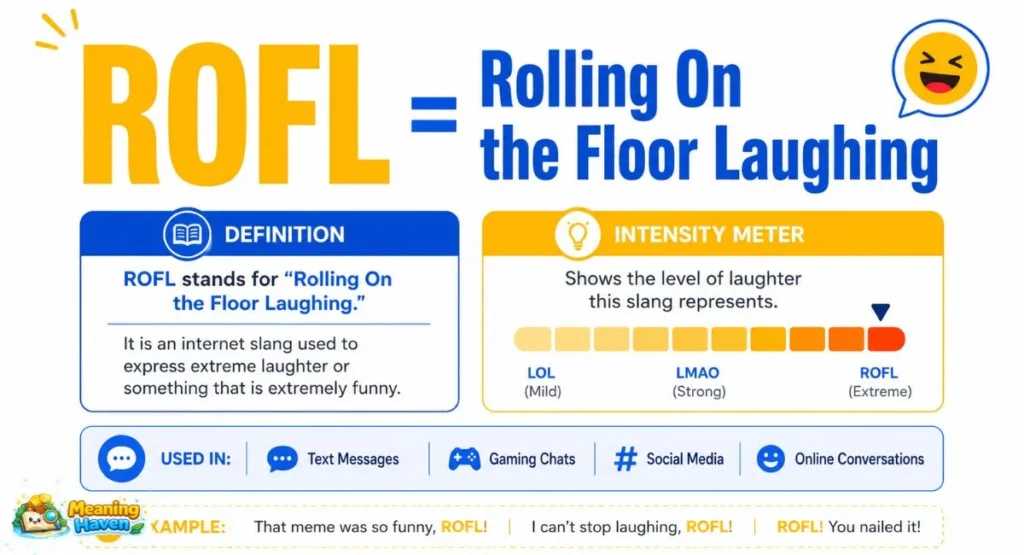
What does ROFL mean in text? It means “rolling on the floor laughing.” The ROFL full form tells you exactly what it expresses — extreme, uncontrollable laughter. It’s one of the most recognized internet abbreviations in American online communication today.
The ROFL definition goes beyond just a funny reaction. It’s a cultural signal. When you type ROFL, you’re telling someone their joke, meme, or story genuinely cracked you up. It’s stronger than a simple “haha” and carries real emotional weight in informal texting.
Quick Definition and Full Form
| Term | Full Form | Tone | Intensity |
| ROFL | Rolling On the Floor Laughing | Playful, Informal | Very Strong |
How Do You Pronounce ROFL?
Most people spell it out — R-O-F-L — rather than saying it as a word. It lives almost entirely in text-based expression. You’d rarely hear someone say “rofl” out loud in a real conversation. It belongs to the world of screens, keyboards, and fast-moving chats.
The Origin and History of ROFL
Internet slang didn’t appear overnight. ROFL grew out of the early internet era of the 1990s. Back then, platforms like AOL Instant Messenger, IRC chat rooms, and early online forums were buzzing with users who needed quick ways to express themselves. Typing speed mattered and character limits were real constraints. Short texting abbreviations became the solution.
ROFL became a staple of chat room slang almost instantly. It joined LOL and LMAO as part of the holy trinity of digital laughter. Linguists who study slang evolution point to this period as the birth of modern online vocabulary — a moment when typed language developed its own emotional shorthand.
When Did ROFL First Appear?
The earliest documented uses of ROFL trace back to the early 1990s in online forums and bulletin board systems. It spread rapidly through gaming communities and college campus networks. By the early 2000s, it had become mainstream millennial slang across the entire United States.
How ROFL Became Mainstream
Pop culture and meme culture pushed ROFL into everyday life. Television shows referenced internet slang. Teenagers adopted it instantly. Teen slang shifted online and ROFL rode that wave straight into the American cultural mainstream. It wasn’t just a phrase anymore — it became a personality.
ROFL vs LOL vs LMAO — What’s the Difference?
Here’s where people often get confused. ROFL vs LOL vs LMAO are all expressions of laughter but they don’t carry the same weight. LOL meaning is mild — a light chuckle, a polite reaction. LMAO meaning cranks it up — something genuinely funny. ROFL meaning explained sits at the top of the ladder, reserved for moments that are truly hilarious.
Think of it like a spice scale. LOL is black pepper. LMAO is jalapeño. ROFL is ghost pepper. You use each one depending on how hard something actually made you laugh. Misusing them flattens your casual conversation and makes your reactions feel hollow.
Laughter Intensity Comparison
| Term | Full Form | Intensity | Best Used When |
| LOL | Laughing Out Loud | Mild | Slightly funny moment |
| LMAO | Laughing My A** Off | Strong | Very funny situation |
| ROFL | Rolling On the Floor Laughing | Very Strong | Extremely hilarious moment |
Can You Combine Them?
Absolutely. ROFLMAO is the most popular combo — it merges ROFL and LMAO into one explosive reaction. It means you’re both rolling on the floor AND laughing your a** off. People use it when something is so funny that a single acronym just doesn’t cut it anymore.
How Is ROFL Used in Text Messages and Online?
ROFL in text messages shows up in dozens of everyday situations. Someone shares a hilarious fail video. A friend texts a ridiculous story about their morning commute. Your group chat explodes with a perfectly timed meme. In all these moments, ROFL is the natural, instinctive reaction that flies off your fingers before you even think about it.
Social media slang lives and breathes through reactions like ROFL. On platforms like X (formerly Twitter), Instagram, and TikTok, you’ll find ROFL scattered through comment sections on viral videos. It signals genuine amusement in a space where most people just drop an emoji and scroll on.
ROFL in Everyday Texting
Real conversations show how to use ROFL better than any definition can. Here’s a quick example:
Jake: “I just waved back at someone who wasn’t actually waving at me. In front of like 20 people.” Maya: “ROFL I cannot 😂”
That exchange captures it perfectly. ROFL lands naturally, quickly, and with zero explanation needed.
ROFL on Social Media Platforms
Online slang terms like ROFL thrive on social media because speed matters. Nobody writes a paragraph to react to a funny post. They drop ROFL and keep scrolling. It functions almost like an emoji alternative — quick, expressive, and universally understood across American digital spaces.
ROFL in Group Chats
Group chats have their own energy. When one person drops ROFL, others pile on. It creates a chain reaction of shared laughter. Online communication in groups depends heavily on these shorthand signals to keep conversations alive and fun without anyone having to type a full sentence.
ROFL Variations and Related Forms
Slang expressions never stay static. ROFL spawned a whole family of creative variations that pushed the humor even further. Americans love to exaggerate for comic effect and internet language reflects that perfectly. These variations show just how playful and inventive internet culture can be.
Each spin-off carries its own flavor. Some are more intense. Some are purely absurdist. All of them trace their DNA back to the original ROFL definition — extreme laughter — but they dress it up differently depending on the context and community.
ROFL Variations Table
| Variation | Full Meaning | Common Context |
| ROFLMAO | Rolling On the Floor Laughing My A** Off | Casual texting, social media |
| ROFLCOPTER | Exaggerated spinning laughter (absurdist) | Meme culture, gaming |
| ROFLLOL | Double laughter emphasis | Informal group chats |
| ROFLWTIME | Rolling On the Floor Laughing With Tears In My Eyes | Extreme reaction texts |
ROFLCOPTER — The Meme Legend
ROFLCOPTER deserves its own spotlight. It originated in early meme culture around the mid-2000s. The joke was that someone was laughing so hard they turned into a helicopter — spinning on the floor with ROFL as their rotor blades. It sounds absurd because it is. That’s exactly why it spread like wildfire across gaming forums and image boards.
When to Use ROFL (and When to Avoid It)
When to use ROFL comes down to one simple question — is the setting casual? If you’re texting friends, reacting to memes, or chatting in a gaming lobby, ROFL fits perfectly. It’s a natural part of informal texting between people who know each other well and aren’t worried about how they come across.
Decode texting slang wrong and you can end up in awkward territory fast. Using ROFL in the wrong setting sends the wrong signal entirely. It can make you look unprofessional, dismissive, or out of touch — none of which helps you in formal or sensitive situations.
Right Contexts for ROFL
ROFL works best in these situations:
- Reacting to a funny meme or video a friend sent
- Responding to a hilarious story in a group chat
- Gaming lobbies and multiplayer chat windows
- Commenting on a viral funny post on social media
- Casual back-and-forth texting with close friends
When ROFL Is Inappropriate
❌ Wrong: “Dear Mr. Henderson, ROFL your quarterly report had some wild numbers.”
✅ Right: “Your report had some surprisingly interesting figures — would love to discuss.”
Keep ROFL out of workplace emails, professional Slack channels, formal messages, and any conversation where someone is sharing something emotional or serious.
ROFL in Gaming and Internet Culture
Gaming slang and ROFL go together like controllers and couch cushions. Fast-paced multiplayer games demand fast communication. Nobody has time to type “that was genuinely hilarious” mid-match. ROFL does the job in four keystrokes. It became a core part of online vocabulary inside gaming communities long before it hit mainstream texting.
Early gaming culture on platforms like Xbox Live, Steam, and World of Warcraft chat made ROFL a daily fixture. Players used it to react to funny fails, unexpected glitches, and ridiculous in-game moments. Internet culture absorbed it from there and spread it everywhere else.
ROFL in Multiplayer Gaming Chats
Player1: “I just accidentally threw a grenade at my own teammate.” Player2: “ROFL bro you are actually cooked 💀”
That exchange happens thousands of times a day across American gaming servers. It’s fast, funny, and universally understood. No translation needed.
ROFL in Meme Culture
Meme culture gave ROFL a second life just when it could have faded out. ROFLCOPTER became a legendary early internet meme. Reddit and 4chan communities kept the term alive through ironic usage and nostalgic callbacks. Even today, older meme formats still carry ROFL energy as a badge of early internet culture pride.
Is ROFL Still Used Today — or Is It Outdated?
Is ROFL still used today? The honest answer is yes — but its role has shifted. ROFL hasn’t disappeared but it no longer dominates the way it did in 2005. The rise of emoji, GIF reactions, and newer slang expressions like “I’m dead” or “I can’t” have taken some of its spotlight away from younger users.
Is ROFL outdated? Not quite. It sits in a comfortable middle ground. Gen Z users might reach for 💀 first but they still know exactly what ROFL means. Millennials use it regularly. Gamers never stopped. It’s more of a classic now than a relic — like vinyl records in a streaming world.
How Younger Generations Use It
Gen Z has its own emoji alternatives for extreme laughter. The 💀 skull emoji means “I’m dead from laughing.” “I can’t” signals helpless amusement. “No because why” is peak Gen Z humor. ROFL still surfaces but usually with a nostalgic or ironic twist among younger American users.
Who Still Uses ROFL Regularly?
Millennials aged 28–43 use ROFL most consistently in everyday texting. Long-time gamers keep it alive in gaming slang contexts. Parents who picked up texting habits in the 2000s still drop ROFL naturally. It’s genuinely multi-generational — just weighted more heavily toward people who grew up with chat room slang as their first digital language.
Other Meanings of ROFL
Beyond laughter, ROFL carries a few niche alternate meanings worth knowing. In some technical and organizational contexts, ROFL appears as an acronym for unrelated terms. Most Americans will never encounter these uses but they exist and understanding them helps you decode texting slang with full confidence.
This is a gap most competitor articles skip entirely. Knowing alternate meanings prevents confusion — especially if you stumble across ROFL in a context where humor doesn’t quite fit.
| Alternative Meaning | Context |
| Remote Operations Flight Line | Military/aviation usage |
| Record of Flight Log | Aviation documentation |
| Rarely used organizational acronyms | Niche professional fields |
In everyday American texting and online communication, ROFL almost always means rolling on the floor laughing. The alternate meanings appear only in highly specific professional environments and are never used in casual conversation.
Frequently Asked Questions About ROFL
What does ROFL mean in text exactly?
What does ROFL stand for is simple — Rolling On the Floor Laughing. It’s an expression of extreme, uncontrollable laughter used in informal texting, social media, and gaming. It signals that something genuinely cracked you up beyond a normal chuckle.
Is ROFL stronger than LOL?
Yes. In the ROFL vs LOL vs LMAO hierarchy, ROFL sits above LOL in intensity. LOL is a mild, almost reflexive reaction. ROFL means you found something genuinely, seriously funny — not just smile-worthy.
Can I use ROFL in professional settings?
No. ROFL is internet slang and belongs in casual spaces only. Keep it out of work emails, professional messages, and formal communications. It reads as unprofessional and can undermine your credibility in workplace settings.
Is ROFL appropriate for kids?
ROFL itself is clean and kid-friendly. However, variations like ROFLMAO contain mild profanity and aren’t appropriate for younger children. Parents should be aware of the difference when helping kids navigate teen slang and online vocabulary.
What’s the difference between ROFL and LMAO?
Both express strong laughter but from different angles. LMAO meaning focuses on intensity of amusement. ROFL meaning explained paints a physical picture — someone literally rolling on the floor. ROFLMAO combines both for maximum comic impact in casual conversation.
Conclusion
What does ROFL mean in text? It means Rolling On the Floor Laughing — one of the most enduring, expressive, and culturally rich pieces of internet slang ever created. From 1990s chat rooms to 2026 gaming lobbies, ROFL has traveled the full length of American digital culture without losing its punch.
Use it in the right context and it adds personality, warmth, and humor to your messages. Misuse it and it can backfire. Now you know exactly when to use ROFL, how it stacks up against LOL and LMAO, and where it lives in the modern texting landscape. Next time someone sends you something genuinely hilarious, you know exactly what to type back. ROFL. 😂

Welcome to Meaning Haven, I’m Muhammad Talha, a content writer and SEO specialist passionate about simplifying word meanings and modern language.
I help readers understand meanings, explore trending slang, and communicate with clarity. My goal is to make language easy, relatable, and useful for everyone.
Let’s explore meanings together!