

You’ve seen it happen. Someone sends a long, thoughtful message and gets back a single letter — K. No explanation. No emoji. Just one cold character sitting on the screen. That tiny reply has sparked countless arguments, bruised feelings, and late-night overthinking sessions across America. But what does K mean in text, really? Is it rude, lazy, or just efficient? The answer isn’t as straightforward as you’d think.
In today’s world of shorthand communication and rapid-fire text messaging, even the smallest replies carry enormous social weight. This guide unpacks every layer behind K — its meaning, its history, its emotional sting, and everything in between.
What Does K Mean in Text?
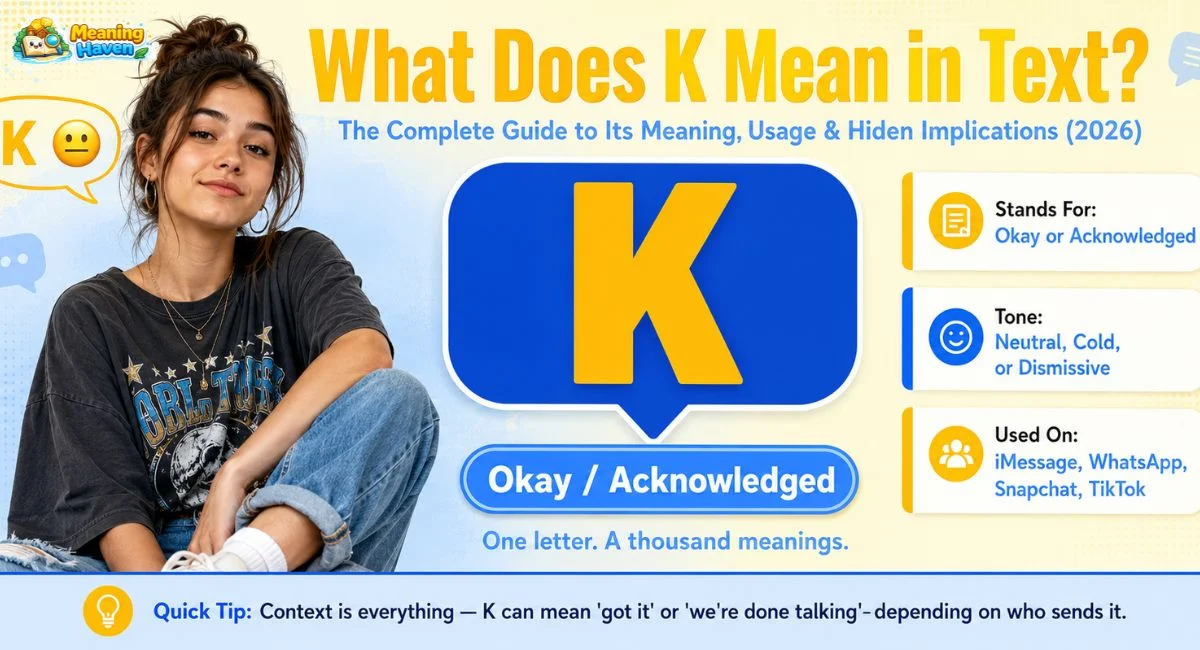
At its most basic level, K is a one-letter reply that means “okay.” People use it in text messaging to confirm something, acknowledge a message, or close out a conversation without much effort. It’s short, fast, and doesn’t require any emotional investment. For a lot of Americans, it’s just part of everyday shorthand communication — nothing more, nothing less.
But K rarely stays that simple in practice. The text response carries layers of meaning depending on who sends it, when they send it, and what came right before it. In one conversation, K means “got it, no problem.” In another, it feels like a door slamming shut. That’s what makes K one of the most fascinating and misread terms in all of internet language today.
Quick Definition at a Glance
K means “okay” or “acknowledged” in texting slang. It’s a stripped-down, single-letter affirmation used across instant messaging platforms in the United States and beyond. Most people send it when they want to confirm something fast without extending the conversation. It functions as a one-letter text that communicates agreement — or sometimes, deliberate distance.
Full Form and What It Stands For
K stands for “okay” — pure and simple. It’s not an acronym. It’s not a code. It’s a OK abbreviation that came from the way Americans naturally say the word “okay” in everyday speech. The letter K captures the hard sound at the start of “okay,” making it the fastest possible way to type that word. In the world of text speak, efficiency usually wins.
Origin and History of K in Texting
K has been around longer than most people realize. It traces its roots back to the early days of SMS texting, when mobile phones had tiny physical keyboards and strict character limits. Back then, shaving a message down to one letter wasn’t laziness — it was just smart. Texting habits formed fast around brevity because every character cost effort and sometimes even money on limited texting plans.
By the time smartphones took over and keyboards got easier, K had already cemented itself in American text conversations. What started as a practical shortcut slowly picked up emotional baggage. As texting norms evolved and people began reading more into their digital exchanges, K stopped being just efficient. It started being interpreted as dismissive, cold, or even passive-aggressive — especially among younger generations who grew up fluent in text decoding.
When Did People Start Using K?
The widespread use of K in text messaging kicked off in the early 2000s. Flip phones ruled the scene and typing “okay” meant pressing multiple buttons just to get three letters out. K solved that instantly. Teenagers across the U.S. adopted it fast as part of their growing texting abbreviations vocabulary. It spread organically, driven purely by the need for speed in everyday digital era communication.
How It Evolved Across Platforms
As platforms changed, K evolved with them. It moved from SMS into iMessage, then into WhatsApp, Instagram DMs, Snapchat, and TikTok comments. Each platform gave it a slightly different communication style. On Snapchat, K keeps streaks alive without conversation. On TikTok, it signals sarcasm or dismissal. On WhatsApp, it wraps up group threads quickly. The word never changed — but its emotional meaning kept shifting depending on where it landed.
How People Use K in Everyday Conversations
In everyday American life, K shows up constantly in online conversations. People drop it to confirm plans, acknowledge reminders, or signal that they’ve read something and don’t have much to add. It’s the texting equivalent of a nod — low energy, low commitment, but still technically a response. For people with busy lives and full notification trays, K keeps communication habits moving without demanding too much.
Context shapes everything, though. Between best friends who text all day long, K barely registers. Between two people navigating a new relationship or a tense situation, K can completely change the energy of a conversation. Social norms of texting in the U.S. have quietly established that the same one-letter reply means different things in different relationships — and good texters know how to read that difference without overthinking it.
Casual Texting and Messaging
In casual, everyday text conversations, K is completely unremarkable. Friends use it to confirm dinner plans, acknowledge funny memes, or wrap up logistics without dragging the chat out longer than necessary. It fits naturally into communication patterns between people who already have an established rhythm. No one reads into it. No one gets hurt. It’s just fast, functional shorthand communication that gets the job done.
Social Media — WhatsApp, Instagram, TikTok, and Snapchat
Every platform handles K a little differently. Here’s how it plays out across the biggest online communication apps in America:
| Platform | How K Is Typically Used | Common Tone |
| Closing group chats or confirming plans | Neutral | |
| Ending DM conversations quickly | Slightly cold | |
| TikTok | Sarcastic comment on dramatic videos | Dismissive |
| Snapchat | Maintaining streaks with minimal effort | Casual |
| iMessage | Quick everyday acknowledgment | Neutral to warm |
Real Chat Examples
Real text message interpretation comes alive through actual examples. Consider these three scenarios:
“Hey, dinner’s at 7 tonight.” → “K.” — That’s pure timely response energy. Clean, efficient, no drama.
“I’ve been really stressed lately and I needed to hear from you.” → “K.” — That lands as a cold response. The emotional context is completely ignored.
“You need to stop texting me.” → “K.” — That reads as a conversation ender, possibly even a digital silent treatment. One letter. Maximum impact.
Is K Rude? What It Really Signals Emotionally
Here’s the truth most people dance around — K isn’t automatically rude, but it absolutely can be. The rude text message reputation that K carries comes directly from the conversational context it appears in. When someone writes three paragraphs about something meaningful and gets a single K back, the imbalance is jarring. That gap between effort given and effort returned is where communication breakdown begins.
The rudeness of K lives entirely in perception. If you and your friend both communicate in short, clipped messages all day, K feels normal. But if someone is already feeling anxious about the relationship — or the conversation was emotionally loaded — K reads as a dismissive reply. The letter itself is neutral. The word choice to use it instead of something warmer is what carries the sting.
When K Feels Dismissive or Cold
K feels coldest when it follows vulnerability. Tell someone something personal and receive K back — that’s a frustrated response that stings deeply. It signals that the other person either didn’t care, didn’t want to engage, or was trying to shut the conversation down. In interpersonal relationships, this kind of communication breakdown can erode trust faster than an argument because it’s so quiet and clean about it. No shouting. Just K.
When K Is Totally Fine to Use
Plenty of situations make K perfectly appropriate. Replying K to “I’ll pick you up at noon” is completely fine — there’s no emotional need for more. In digital communication, not every message requires warmth or effort. Logistical exchanges, quick confirmations, and low-stakes updates don’t need a warm reply. Polite communication doesn’t always mean lengthy communication. Sometimes a K is just a K — efficient, harmless, and done.
K From a Girl vs. K From a Guy — Does It Mean Something Different?
This question shows up constantly in American texting psychology discussions, and the honest answer is: yes, sometimes. A girl sending K after an emotional exchange often signals emotional intelligence being withheld on purpose — she’s checked out or frustrated. A guy sending K mid-conversation usually just means he’s distracted or unbothered. These aren’t rules. They’re social behavior patterns that show up consistently in American digital relationships, especially in dating contexts.
K in Hood Slang and Online Communities
In American hood slang and urban communities, K takes on a sharper, more deliberate edge. It’s used as a blunt sign-off that communicates finality without aggression. Saying K in these online conversations signals that a point has been made, a decision is final, or a topic is closed. It’s not passive. It’s direct. In this communication style, K functions less like a shy acknowledgment and more like a period at the end of a hard sentence.
Online communities across Reddit, Discord, and Twitter have given K an entirely new sarcastic life. Drop a K under someone’s emotional rant and you’ve made a power move. It signals that you’re completely unbothered — that their words didn’t land, didn’t matter, or didn’t deserve more than one letter. In internet language communities, this usage of K has become its own art form — the ultimate low-effort clap back.
What Does K Mean in Hood Slang?
In hood slang, K signals dominance and finality. It’s the verbal equivalent of walking away mid-conversation without looking back. When used in text conversations within urban American communities, K communicates that there’s nothing left to say — not because the person is sad or hurt, but because they’re done. It’s a communication cue that carries authority, not weakness, in this particular cultural context.
K in Dating Apps and DMs
Getting K on a dating app is almost never a good sign. On platforms like Tinder, Hinge, or Bumble, K functions as soft ghosting. The person is still technically responding — but the message intent is clear. They’re not interested enough to try. In the world of digital relationships, a K in a romantic DM often means the other person is keeping you on the back burner while investing their energy elsewhere. It’s authentic communication at its most honest — just not in the way you hoped.
Different Meanings of K Beyond Texting
K doesn’t just mean “okay” in a text. Step outside of text messaging and this letter carries completely different meanings across science, finance, sports, and pop culture. Americans switch between these definitions constantly in everyday conversation, sometimes within the same sentence. Recognizing the difference is a core digital communication skill that prevents a lot of unnecessary confusion — especially in professional or educational settings where multiple meanings collide.
Understanding these alternate meanings also helps with text message interpretation in mixed-context conversations. When your boss says “she pulled in 120K last quarter,” that’s not slang. When your friend texts “K” after a fight, that’s not a salary reference. Message clarity depends on knowing which version of K you’re dealing with — and in digital era communication, those lines blur more often than you’d expect.
K as a Number (Thousand)
K means one thousand when used in numerical contexts. It comes from the Greek word kilo, meaning thousand, and appears constantly in American online communication around social media metrics, salaries, and business figures. “She has 50K followers” means fifty thousand. “He earns 75K a year” means seventy-five thousand dollars. This OK abbreviation has nothing to do with texting slang — it’s just math dressed up as a letter.
K in Science, Sports, and Other Fields
| Field | What K Means |
| Chemistry | Potassium (element symbol) |
| Physics | Kelvin (temperature unit) |
| Baseball | Strikeout (scoring notation) |
| Finance | Thousand dollars |
| Music | Used in genre tags (K-pop) |
| Greek/Metric | Kilo (1,000 units) |
These field-specific definitions rarely cause confusion in person — but in digital communication, where messages strip away body language and tone of voice, the wrong K in the wrong conversation can throw things off completely.
Common Misconceptions and Wrong Interpretations of K
People misread K constantly — and most of the time, they’re projecting more into it than is actually there. The biggest misconception is that K always carries attitude. It doesn’t. Many Americans use K purely out of communication habits built around efficiency, not emotion. Assuming every K is loaded with negative subtext creates unnecessary tension in relationships that were perfectly fine before the overthinking started.
The real problem isn’t the letter — it’s the texting misunderstandings that form when people read their own emotional state into someone else’s message. If you’re already feeling insecure about a conversation, K feels threatening. In a secure, easy dynamic, K doesn’t even register. Emotional intelligence in texting means learning to separate your feelings from the actual message intent before reacting.
Thinking K Always Means Someone Is Angry
K does not equal anger by default — not even close. Plenty of people, especially older millennials and Gen X Americans, use K purely because of texting habits formed around brevity. No rage behind it. No coldness. Just speed. Jumping to conclusions about angry texting based on one letter poisons perfectly good conversations. Before assuming the worst, ask yourself whether this person has shown other signs of frustration — or whether K is just how they text.
Confusing K With KK
K and KK look similar but they land very differently. KK reads as warm, upbeat, and friendly — almost enthusiastic. K reads as flat, minimal, and sometimes cold. Mixing them up in practice matters because emoji usage and punctuation choices in texting carry real social cues. Sending K when KK was expected can accidentally introduce a cold response into an otherwise warm conversation. One extra letter changes the entire emotional context of the reply.
Assuming K Is Unprofessional in All Contexts
K is informal — but calling it universally unprofessional oversimplifies things. In casual workplace messaging on Slack or Microsoft Teams, K slides into conversation naturally between colleagues who communicate informally all day. Text message etiquette depends heavily on your audience and environment. With your direct manager or a client, skip it entirely. With your work friend who texts you memes during lunch? K is completely fine and no one thinks twice about it.
K vs. OK vs. KK — What’s the Difference?
These three replies look almost identical on paper but hit completely differently in practice. “OK” lands as neutral and complete — a balanced acknowledgment that doesn’t push anyone away. “K” lands as minimal and sometimes cold — an acknowledgment that seems almost reluctant. “KK” lands as warm and friendly — the most socially safe version of the three. Punctuation in texting and letter repetition carry more communication cues than most people consciously realize.
Americans make this choice instinctively in every conversation. You send KK to your best friend. You send OK to your coworker. You send K when you’re checked out of the conversation. These aren’t random choices — they’re part of a deeply ingrained communication style that reflects how engaged, warm, or done you actually are. Clear messaging sometimes means choosing the right version of okay more carefully than you’d think.
Similar Slang Terms and Alternatives
| Term | Full Meaning | Emotional Tone |
| K | Okay | Neutral to cold |
| KK | Okay okay | Warm, friendly |
| OK | Okay | Balanced, neutral |
| Mkay | Okay (soft) | Casual, playful |
| Bet | Agreed / sounds good | Confident, cool |
| Aight | Alright | Laid-back, casual |
| Sure | Agreement | Neutral to sarcastic |
| Noted | Acknowledged | Professional, slightly cold |
| Fr | For real | Emphatic agreement |
| Word | Understood / agreed | Cool, unbothered |
How to Respond When Someone Texts You K
Getting K in a text doesn’t have to spiral into an emotional crisis — even though it sometimes feels that way. How you respond depends entirely on the relationship, the conversation, and honestly, your own energy in that moment. Communication effectiveness in texting comes from reading the full picture, not just reacting to a single letter. Sometimes K is a brush-off. Sometimes it’s nothing at all.
The smartest move is usually to stay unbothered. If K ended a conversation that was already winding down, let it end. If it showed up in the middle of something meaningful, a calm and light reply usually resets the tone better than any confrontation would. Emotionally intelligent texting means you respond to the intent behind the message — not just the two-pixel letter sitting on your screen.
Casual and Friendly Replies
When K lands in a low-stakes conversation, match the energy and keep it moving. Try “sounds good,” “cool,” or just continue with whatever you were talking about. There’s no need to make it weird. Benefit of the doubt goes a long way in maintaining healthy digital relationships. Not every K deserves analysis. Most of them just need a simple, easy reply that keeps the conversation alive without turning one letter into a whole moment.
Funny Comebacks
If the K felt intentionally cold or dismissive, humor disarms the tension better than anything else. Try something like “wow, a whole letter 🙏” or “K-ing me like that, huh?” These light, conversational tone replies show that you noticed the energy without making it dramatic or needy. Americans respond really well to this approach in texting conflict situations — it’s playful, confident, and signals that you’re unbothered enough to laugh about it.
Is K Appropriate in Professional Communication?
Short answer — skip it at work unless you really know your audience. In formal emails, K reads as dismissive reply energy that no professional exchange needs. In text message etiquette for workplace settings, “sounds good,” “noted,” or “will do” always land better. In casual Slack chats with close colleagues, K can slide by without issue. The rule is simple: the higher the professional stakes, the more effort your reply deserves. K just isn’t worth the risk in serious digital communication settings.
FAQs About K in Texting
What does K mean in text?
K meaning in text is simple — it means “okay.” It’s a one-letter acknowledgment used in text messaging to confirm, agree, or close out a conversation. Its emotional meaning shifts based on context, relationship, and timing. A K after a logistics message is fine. A K after a heartfelt conversation can feel like a cold response that stings.
Is K rude?
K isn’t automatically rude but it earns that reputation for a reason. When someone sends an effortful message and receives K back, the gap creates a communication breakdown that feels dismissive. American texting etiquette has quietly established that K carries risk in emotional conversations. In casual exchanges, though, it’s completely harmless. Context is everything here.
What does KK mean?
KK means “okay okay” and reads far warmer than a lone K. It’s an enthusiastic, agreeable reply that signals genuine engagement. In texting slang, KK is the friendlier, safer version of K — less flat, less cold, and far less likely to be misread. If K is a nod, KK is a smile.
What does K mean from a girl?
From a girl, K often carries hidden meaning — especially in romantic or emotionally charged conversations. In American texting culture, a girl sending K after something meaningful usually signals she’s done engaging or quietly frustrated. In low-stakes texts, though, it might mean absolutely nothing. Conversational context always determines which version it is.
What does K mean from a guy?
Guys typically send K as a pure efficiency move with no emotional subtext behind it. In male communication patterns, K usually means “read it, got it, moving on.” That said, a K after a serious conversation still carries negative subtext if the situation calls for more. Even guys get called out for bad texting etiquette when K shows up at the wrong moment.
What’s the difference between K and OK?
OK feels complete and balanced — it’s a full acknowledgment with neutral energy. K feels trimmed and sometimes cold. The tonal difference between these two is subtle but real. Americans instinctively feel it even when they can’t explain it. Word choice in texting is a form of body language in digital spaces — and K versus OK speaks volumes about your level of engagement.
Why do people text just K?
People text K because it’s the fastest possible acknowledgment in digital communication. In a world of constant notifications and device addiction, typing one letter is sometimes all the bandwidth someone has. It’s not always personal. Sometimes K is just shorthand communication doing its job — confirming receipt without opening another conversation thread that neither person has time for right now.
Conclusion
That single letter has more layers than most people ever stop to consider. K travels from simple acknowledgment to passive-aggressive brush-off depending on who sends it, when they send it, and what came right before it. Understanding K meaning in text means understanding that digital communication isn’t just about words — it’s about the space between them, the effort behind them, and the relationship carrying them forward.
Now you’ve got the full picture. You know the history, the emotional weight, the cultural context, and the practical playbook for responding when K lands in your inbox. One letter. Dozens of interpretations. The next time someone hits you with a K, you’ll know exactly what you’re reading — and exactly how to handle it.

Welcome to Meaning Haven, I’m Muhammad Talha, a content writer and SEO specialist passionate about simplifying word meanings and modern language.
I help readers understand meanings, explore trending slang, and communicate with clarity. My goal is to make language easy, relatable, and useful for everyone.
Let’s explore meanings together!