 Skip to content


If you searched what does ima mean in text, you are probably in the same position as many other readers. You saw “ima” in a message, comment, or social media post, and now you want a quick and clear answer. The problem is that many websites make this simple question feel harder than it should be. Some pages give mixed meanings too early, some are too thin to be useful, and others do not explain the term in a way that feels easy for beginners. This creates a real pain point for students, parents, non-native English speakers, and everyday users who just want to understand the slang without wasting time.
While analyzing the competitor pages for this keyword, I noticed the same pattern again and again: the strongest opportunity is not just giving the meaning, but giving it in the right order. Readers first want the main meaning, then simple examples, and only after that the less common meanings. That is why this article is written differently. It starts with the answer most people are actually looking for, explains the usage in plain English, and then clears up the confusion around other meanings and similar forms. In most text messages, ima usually means “I’m going to,” and in some cases it can also mean “I’m about to.” This guide is built to help you understand that fast and with confidence.
Quick Takeaway
- ima usually means “I’m going to”
- in some cases, it can also mean “I’m about to”
- it is casual slang
- it is common in texts, chats, and social media
- it is not ideal for formal writing
What Does Ima Mean in a Text Message?
The most common meaning of ima in text is:
I’m going to
Sometimes, depending on the sentence, it can also mean:
I’m about to
Quick examples
- ima call you later = I’m going to call you later
- ima leave now = I’m about to leave now
- ima tell her tonight = I’m going to tell her tonight
This is the meaning most readers need first. That is why it should come before less common meanings.
At a Glance
- Primary meaning: I’m going to
- Secondary meaning: I’m about to
- Less common meaning: I Must Admit
- Tone: informal
- Best used in: texts, DMs, comments
- Avoid in: emails, school essays, professional writing
Simple Meaning in Easy English
For beginners, the easiest way to understand ima is this:
- it is a casual texting word
- it usually comes before an action
- it often means the person will do something soon
Example
- ima sleep = I’m going to sleep
- ima eat now = I’m about to eat now
This makes the term easier for students and non-native English speakers to understand.
Why People Use Ima
People use ima because it is:
- short
- fast
- easy to type
- common in texting
- natural in casual online speech
Instead of writing:
- I am going to call you
- I’m going to leave
- I am about to go
People write:
- ima call you
- ima leave
- ima go
That is why it appears so often in chats and on social media.
How People Use Ima Online
This section is useful for teenagers, students, and social media users.
In text messages
- ima text you later
- ima head home now
- ima be there soon
On TikTok or Instagram
- ima post this later
- ima try this trend
- ima be honest
In group chats
- ima join in 5
- ima send the pic
- ima go offline now
Across platforms, the meaning usually stays the same: I’m going to.
Real Examples With Standard English

This section helps readers who want a very clear translation.
| Casual text | Meaning | Standard English |
| ima call u later | I’m going to | I’m going to call you later |
| ima head out | I’m about to | I’m about to leave |
| ima eat now | I’m about to | I’m about to eat now |
| ima tell him | I’m going to | I’m going to tell him |
| ima be there soon | I’m going to | I’m going to be there soon |
This kind of example-based explanation is especially useful for mobile users and ESL readers.
Ima vs Imma vs I’ma
Many people also search for related forms like imma and I’ma.
Most of the time, these forms are very close in meaning. They usually point to “I’m going to.” The related form imma is widely defined as a casual short form of “I’m going to.”
Simple rule
- ima = casual
- imma = casual
- I’ma = casual
Example
- ima go now
- imma go now
- I’ma go now
These usually mean the same thing in casual writing.
| Term | Most common meaning | Use case | Formal or informal |
|---|---|---|---|
| ima | I’m going to | texting, chat, social media | informal |
| imma | I’m going to | texting, chat, slang | informal |
| I’ma | I’m going to | casual writing | informal |
| I’m a | I am a | normal grammar | can be formal or informal |
Ima vs I’m a
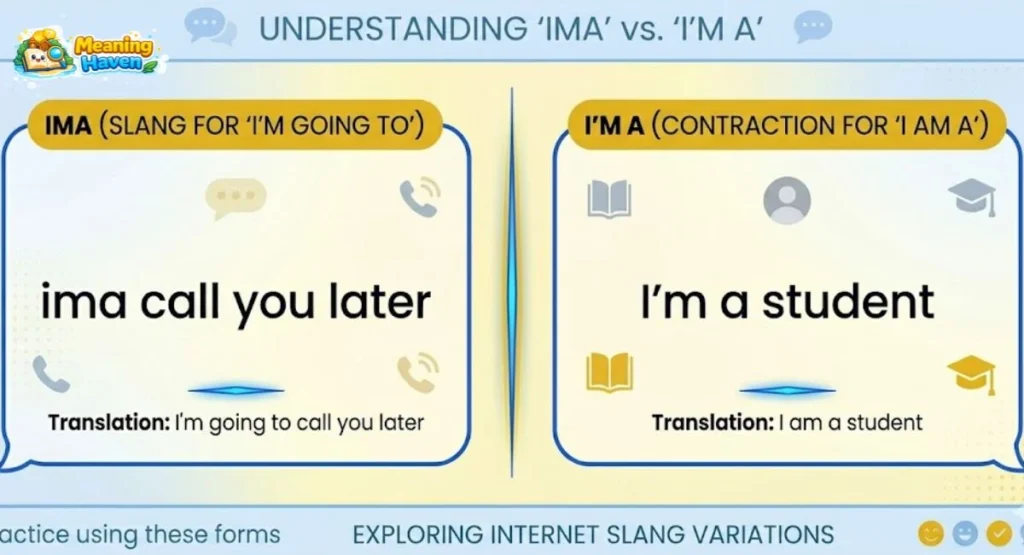
This is one of the biggest confusion points.
In most texting contexts, ima means “I’m going to.” But some readers may read ima as a casual spelling of “I’m a” if it comes before a noun instead of a verb. That confusion is one reason some sites define it differently.
Compare these:
- ima call you = I’m going to call you
- I’m a student = I am a student
Easy rule
- if ima comes before a verb, it usually means I’m going to
- if it comes before a noun, readers may hear it closer to I’m a
This helps clear up one of the biggest SERP confusion points.
Other Meanings of IMA
In normal texting, the primary meaning is still “I’m going to.”
But there are some less common meanings too. One example is “I Must Admit.” In business or non-text contexts, IMA can also stand for an organization or technical term, such as Institute of Management Accountants.
That is why context matters.
Lowercase “ima” vs Uppercase “IMA”
Lowercase ima is usually used in casual chat. It often points to the slang meaning “I’m going to.”
Uppercase IMA can sometimes look more like an acronym. In that case, the meaning may depend on the field, topic, or sentence.
Quick rule
- ima = usually texting slang
- IMA = may be slang, or it may be an acronym
Primary Meaning vs Secondary Meanings
To keep things simple:
Primary meaning
- I’m going to
Secondary meanings
- I’m about to
- I Must Admit
- acronym meanings in other contexts
This order is important. The primary texting meaning should come first because that is what most searchers want.
How to Tell the Meaning from Context

This section is for readers who are confused because different websites give different answers.
Examples
- ima call you later → I’m going to
- ima leave now → I’m about to
- IMA, that was my fault → I Must Admit
- IMA in a business article → may be an acronym, not texting slang
Best way to decode it
Look at the word after ima:
- if it is a verb, it usually means future action
- if it is a noun, the meaning may change
- if it is in all caps, check whether it is an acronym
This is one of the most useful sections for readers who saw conflicting meanings online.
| Example | Meaning |
|---|---|
| ima call you later | I’m going to |
| ima leave now | I’m about to |
| IMA, that was my fault | I Must Admit |
| IMA in a business article | acronym, not texting slang |
Is Ima Slang?
Yes. Ima is slang.
It is informal. It is fine in:
- texts
- group chats
- social media
- casual online messages
It is not ideal for:
- work emails
- school essays
- formal reports
- professional communication
This matches the way competitor pages frame the term.
Is Ima Rude?
No, ima is not usually rude.
It is just casual. But it can look too informal in serious or professional situations. That is why it is better to use standard English when the setting is formal.
Is Ima Appropriate for Professional Use?

In most cases, no.
Do not use ima in:
- business emails
- school assignments
- job applications
- client messages
- professional writing
Better options
- I’m going to send the report
- I will reply soon
- I am about to join the meeting
This helps older users, teachers, and workplace readers who want to know whether the term is appropriate.
Common Mistakes When Using Ima
1. Using it in formal writing
This is the biggest mistake.
2. Confusing it with “I’m a”
This happens a lot.
3. Ignoring context
The sentence matters.
4. Assuming every site gives the same definition
Some pages give mixed or weak explanations. That is why this keyword needs a clear answer.
Similar Slang Words
If you searched this keyword, you may also want to know these related slang words:
Imma
Means almost the same thing.
Gonna
Means going to.
Bouta
Means about to.
Finna
Another slang word for future action.
These related terms are useful for readers who want a broader understanding of texting slang.
| Slang term | Meaning |
|---|---|
| imma | I’m going to |
| gonna | going to |
| bouta | about to |
| finna | going to / about to |
Common Mistakes
- thinking ima always means only one thing
- confusing ima with I’m a
- using ima in formal writing
- ignoring whether the next word is a verb or a noun
Frequently Asked Questions
What does ima mean in text?
It usually means “I’m going to.” In some sentences, it can also mean “I’m about to.”
Is ima the same as imma?
Often, yes. They are very similar in casual writing.
Is ima slang?
Yes. It is informal slang used in texting and online chat.
Can I use ima in professional messages?
No. Standard English is better for formal communication.
What is the difference between ima and I’m a?
In most texting contexts, ima points to future action, while I’m a shows identity. But context matters.
Can IMA have other meanings?
Yes. It can also mean “I Must Admit” or stand for an acronym in other fields.
What does ima mean on TikTok or Snapchat?
It usually means “I’m going to” there too. The meaning usually stays the same across social platforms.
Conclusion
After reviewing the competing articles and fact-checking the main explanations, one thing became very clear to me: the biggest issue with this keyword is not the slang itself, but the confusion caused by weak and inconsistent content. A trustworthy article needs to do more than repeat definitions. It needs to explain the main meaning first, show how the word works in real sentences, and only then mention the less common meanings. Based on that analysis, the clearest and most useful explanation is this: in most text messages, ima means “I’m going to,” and in many situations it can also be understood as “I’m about to.” From both an editorial and search-intent point of view, that is the strongest way to guide the reader. When I looked at how this term is explained across the SERP, it became obvious that readers do not want a complicated answer.
They want a simple, accurate, and experience-backed explanation that helps them understand the word right away. That is why the safest first reading of ima in a text is usually a future action, and once you check the sentence around it, the meaning becomes much easier to understand.

Welcome to Meaning Haven, I’m Muhammad Talha, a content writer and SEO specialist passionate about simplifying word meanings and modern language.
I help readers understand meanings, explore trending slang, and communicate with clarity. My goal is to make language easy, relatable, and useful for everyone.
Let’s explore meanings together!
2 thoughts on “What Does Ima Mean in Text? Full Meaning, Examples, and How to Use It”