 Skip to content

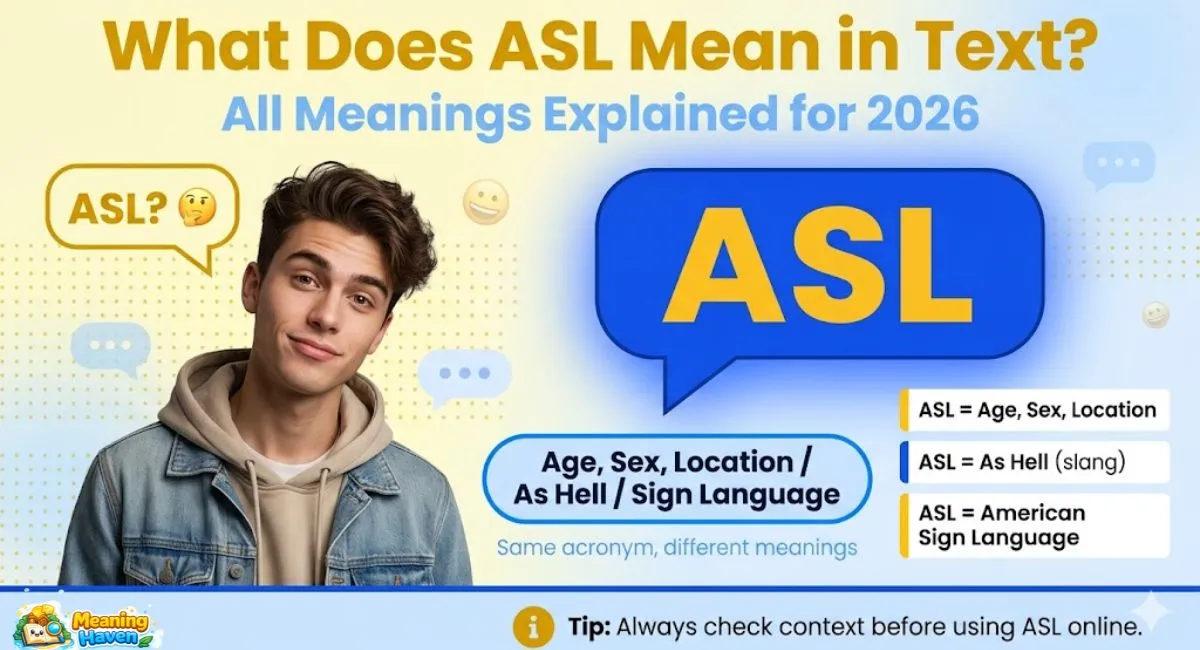
If you’ve ever come across the acronym “ASL” in text messages, social media, or online chats, you’re not alone in wondering what it actually means. Is it Age, Sex, Location? Or is it just someone emphasizing how tired they are, saying they’re “tired as hell”? For many, the shifting meanings of this simple three-letter acronym can be confusing, especially when it’s used in different ways depending on the context and platform. Whether you’re texting a friend, posting on TikTok, or chatting on Snapchat, it’s essential to understand the changing nature of internet slang to communicate effectively and avoid awkward misunderstandings.
As someone who has worked in digital communication for years, I’ve seen firsthand how slang like ASL has evolved over time. What started as a quick shorthand in early chatrooms for “Age, Sex, Location” has now become a popular way of expressing emphasis, especially among Gen Z, as in the slang term “as hell.” As social media platforms continue to shape language, it’s crucial to keep up with these changes—not only to fit in with current trends but also to ensure your safety and privacy online. In this guide, I’ll help you decode ASL and provide you with the insights you need to use it correctly, without the confusion.
Key Takeaways
- ASL in Text: Can mean Age, Sex, Location, “As Hell”, or American Sign Language depending on the context.
- Platform-Specific Usage:
- Snapchat: Primarily Age, Sex, Location
- TikTok: Commonly “As Hell” for emphasis
- Responding to ASL: It’s important to set privacy boundaries when responding to ASL in online chats.
- Evolution of Slang: ASL has shifted from its early usage in chatrooms to modern internet slang—reflecting how language evolves online.
What is ASL?
ASL is a commonly used acronym in texting, chatting, and on social media. The meaning of ASL depends on the context of the conversation and the platform. Let’s dive into the different meanings of ASL and how it’s used.
1. ASL: Age, Sex, Location
The oldest meaning of ASL is “Age, Sex, Location.” It was used mainly in the early days of online chatrooms, especially on platforms like AOL Instant Messenger (AIM) and IRC. This abbreviation was used to quickly ask for a person’s basic details, especially in random chats or when meeting strangers online.
Example:
- Person 1: “Hey, ASL?”
- Person 2: “25/F/New York” (Age 25, Female, Location New York)
This meaning of ASL is still seen today, but it’s less common as people prefer to use more direct and detailed ways to share personal information.
Social Media Users:
Understanding this old-school meaning of ASL is still helpful if you’re interacting with someone in an online chat or dating app, especially in more informal contexts. While this abbreviation might feel outdated to some, it still occasionally pops up on platforms like Snapchat or older messaging apps.
2. ASL: As Hell
In modern texting slang, particularly among Gen Z users, ASL often means “as hell”. This slang is used to add emphasis or show extreme intensity about something. It’s used in informal chats and usually represents an exaggerated emotion.
Example:
- “I’m tired ASL this morning.”
- “That movie was boring ASL.”
In this context, ASL replaces words like “very” or “extremely” to make statements stronger.
Young Adults & Gen Z:
This modern slang interpretation of ASL is highly relevant for Gen Z and younger social media users. Platforms like TikTok and Instagram frequently see this usage, often appearing in captions, comments, or casual conversations.
Example:
“That video was hilarious ASL.”
This usage is an essential part of staying current in texting or social media chats, and is an easy way to show excitement or emphasis.
3. ASL: American Sign Language
Lastly, ASL also stands for American Sign Language, which is the primary language used by the Deaf community in the United States. While this meaning of ASL is still very relevant, it is rarely used in casual texting. However, it’s important to distinguish between the acronym used in chats and the formal use of ASL in the Deaf community.
Example:
- “She’s fluent in ASL.”
- “I’m taking ASL classes.”
This version of ASL is used in educational or professional settings when talking about the Deaf community or learning sign language.
Language Enthusiasts:
Understanding American Sign Language can be particularly valuable for those interested in language learning or exploring how languages evolve. If you’re someone who wants to learn more about sign language or the Deaf community, this version of ASL has immense value in educational contexts.
History of ASL: The Evolution of the Term
ASL originally stood for “Age, Sex, Location” in the early days of the internet. It was a common shorthand used in online chatrooms, such as AOL Instant Messenger (AIM) and IRC, as a quick way to break the ice and get to know someone’s basic information. This abbreviation became a standard part of internet culture, particularly in the late 1990s and early 2000s.
However, over time, as technology and online communication evolved, ASL also gained a modern meaning: “As Hell”. The slang usage emerged with the rise of texting, social media platforms like TikTok and Instagram, and the casual language of younger generations. While Age, Sex, Location still has its place in specific contexts, asl = “as hell” has become the dominant interpretation in today’s informal communication.
This evolution shows how language adapts to new platforms and communities, making ASL a prime example of how online slang evolves.
How to Tell Which Meaning of ASL is Being Used
The meaning of ASL can be tricky to figure out, especially when reading a text message or social media post. Here’s how you can decipher the correct meaning:
1. Look at the Context
- If ASL is at the beginning of a conversation, especially with someone you don’t know, it likely means Age, Sex, Location.
- If ASL is used mid-sentence, especially with emotional or intense statements, it’s probably as hell.
- If ASL is part of a sentence about language or culture, it most likely refers to American Sign Language.
2. Pay Attention to Capitalization
- ASL (all caps) often refers to American Sign Language or Age, Sex, Location.
- asl (lowercase) usually means as hell, which is the more modern slang.
Where is ASL Used?
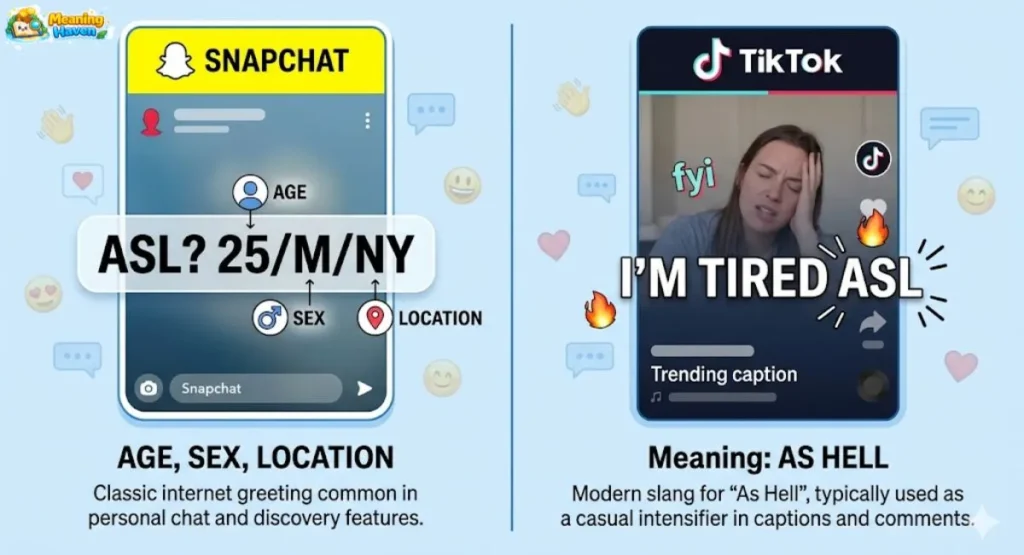
ASL is used in different platforms and social contexts, and its meaning varies accordingly. Here’s a breakdown of how it’s used on different platforms:
ASL on Snapchat
On Snapchat, ASL usually means Age, Sex, Location. People use it as a quick way to ask for basic personal details when chatting with someone new.
Example:
- ASL?
- 25/M/NY
ASL on TikTok and Instagram
On TikTok and Instagram, ASL is commonly used to mean as hell. It’s a way of emphasizing emotions or actions.
Example:
- “That video was fun ASL.”
- “I’m tired ASL today.”
ASL in Texting/Online Chats
In online chats, ASL can mean either Age, Sex, Location or as hell, depending on the context. It’s important to understand the tone and the way the message is framed.
Example (Age, Sex, Location):
- ASL?
- 24/F/Chicago
Example (as hell):
- “This homework is hard ASL.”
| Meaning of ASLContextPlatform Examples | ||
|---|---|---|
| Age, Sex, Location | Traditional/Chatrooms | Snapchat, Early Internet |
| As Hell | Modern Slang | TikTok, Instagram, Texting |
| American Sign Language | Educational/Professional | Deaf Communities, Learning ASL |
Is ASL Rude?
ASL is not inherently rude. However, it can feel intrusive or abrupt if asked by a stranger, especially the Age, Sex, Location version. It’s important to be mindful of the situation and the person you are chatting with.
If you are unsure, it’s always good to set boundaries and decide how much information you are comfortable sharing.
Example of setting boundaries:
- “I’d rather not share that right now.”
- “Let’s talk more first!”
How to Respond to ASL
When someone asks you ASL, here are some ways you can reply:
Casual Response:
- “22/M/NY” (Age, Sex, Location)
Funny Response:
- “300/Wizard/Hogwarts” (If you want to be playful)
Privacy-Conscious Response:
- “I’d rather not share my details.”
Safe Reply for Strangers:
- “Let’s chat first before sharing personal info.”
Should You Use ASL?
Whether or not to use ASL depends on the situation:
- When to use ASL: It’s fine to use ASL if you’re chatting casually with friends, on social media, or in online gaming.
- When to avoid ASL: If you’re chatting with strangers or in formal contexts, avoid asking for personal details or using slang like ASL.
FAQs
What is the difference between asl and ASL?
- asl (lowercase) is commonly used in slang to mean “as hell”.
- ASL (uppercase) often refers to “Age, Sex, Location” in older chat contexts or American Sign Language in professional or educational settings.
Can you use ASL in professional settings?
- No, it’s generally not appropriate to use asl (as hell) or Age, Sex, Location in formal or professional communications. However, ASL (American Sign Language) is used in educational and healthcare settings to communicate with the Deaf community.
Is ASL safe to ask in dating apps?
- While it’s common to see Age, Sex, Location on dating apps, asking ASL directly may be perceived as too forward or intrusive, depending on the context. It’s better to ask open-ended questions to get to know someone rather than immediately asking for personal details.
Visual Example: How ASL Changes Across Platforms
| Platform | Meaning of ASL | Example |
| Snapchat | Age, Sex, Location | ASL? 25/M/NY |
| TikTok | As Hell | “That video was fun ASL“ |
| As Hell | “I’m tired ASL today” | |
| Texting | Age, Sex, Location / As Hell | “ASL?” 24/F/Chicago or “This homework is hard ASL“ |
Quick Tip
When using ASL in texting, always check the context—whether you’re talking to a friend or a stranger—so you know if it means **”Age, Sex, Location”** or **”As Hell.” Be mindful of **privacy** in online chats.
Conclusion
Over the years, I’ve seen how ASL has evolved from its use as “Age, Sex, Location” in early chatrooms to becoming a modern slang term that means “as hell” in platforms like TikTok and Instagram. As someone who’s worked in content creation and online communication, I know how quickly language can shift and how important it is to understand these changes. Being able to decode terms like ASL allows you to communicate more effectively, engage in conversations without feeling out of place, and stay aware of privacy concerns, especially when asked for personal details in online chats.From my experience, language on the internet is constantly evolving, and staying informed about terms like ASL helps not just with staying current but also with avoiding potential miscommunication or privacy risks.
Whether you’re chatting with friends, engaging in professional discussions, or exploring new platforms, understanding the context of terms like ASL gives you the confidence to navigate online spaces safely. Having spent years in digital communication, I can confidently say that knowing these details makes a difference in how you express yourself online and how well you understand the conversation at hand.

Welcome to Meaning Haven, I’m Muhammad Talha, a content writer and SEO specialist passionate about simplifying word meanings and modern language.
I help readers understand meanings, explore trending slang, and communicate with clarity. My goal is to make language easy, relatable, and useful for everyone.
Let’s explore meanings together!
3 thoughts on “What Does ASL Mean in Text? Exploring Its Different Meanings”