 Skip to content

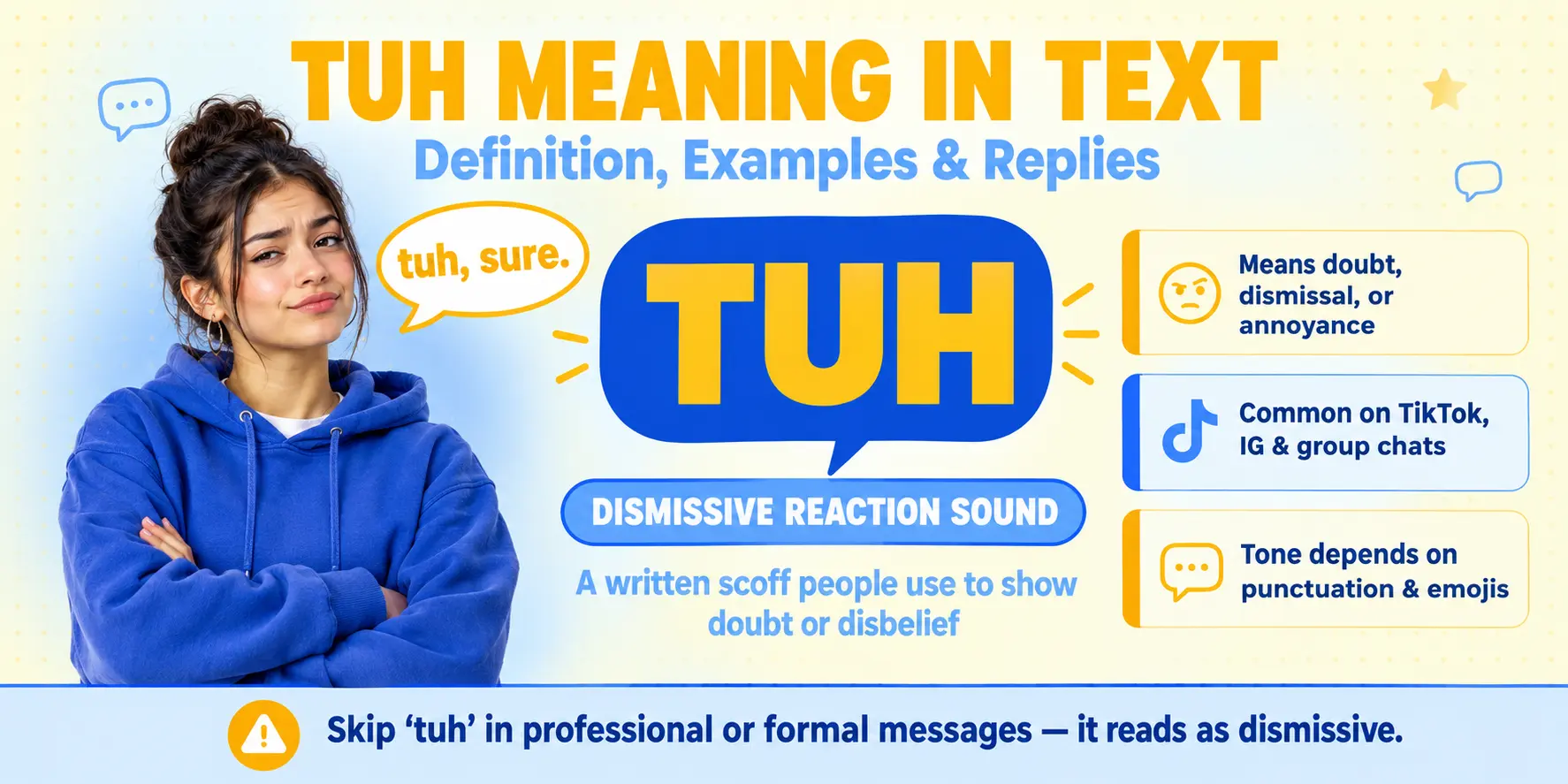
Tuh is a written version of a scoffing or dismissive sound, close to “tch” or “pfft.” People type it to show disbelief, annoyance, sarcasm, or doubt about something someone just said.
You’ll see it in texts, comments, and captions most often as a short reaction on its own, not as part of a full sentence. The tone almost always depends on the words around it and any emoji attached.
A few people also use “tuh” as a phonetic spelling of “to” or “too,” but that’s rare compared to the reaction use. Context tells you which one you’re looking at fast.
| Term | Meaning | Common Context |
|---|---|---|
| tuh | dismissive/doubtful reaction sound | replying to a claim you don’t buy |
| tuhhh | same meaning, stretched for emphasis | reacting to something shocking or annoying |
| tuah | unrelated slang term with its own separate meme origin | often confused with “tuh,” but not the same word |
“Tuh” isn’t a real goodbye or greeting, and it doesn’t work as a standalone sentence starter. It’s closer to a grunt you’d make out loud than a word you’d use to open a message.
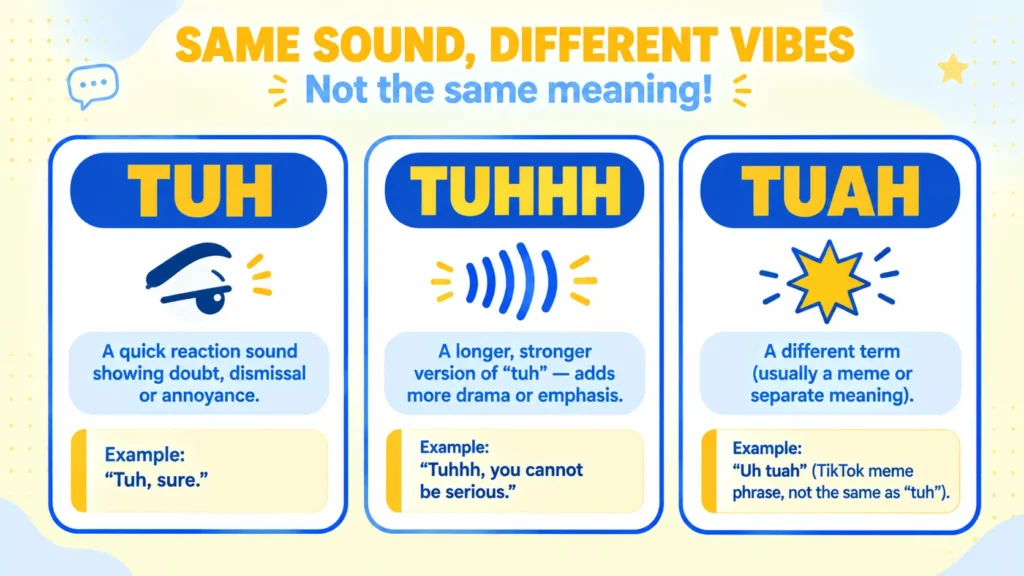
Tuh Meaning & Definition
“Tuh” doesn’t stand for anything. It’s not an acronym, so there’s no letter-by-letter breakdown here. It’s a phonetic spelling of a short, sharp exhale people make when they’re skeptical or annoyed.
Here’s what it usually signals:
- Literal meaning: a written scoff or click of the tongue
- Common texting meaning: disbelief, dismissal, or mild annoyance
- Typical purpose: reacting to a claim, excuse, or statement you find hard to believe
- Emotional tone: ranges from playful to genuinely irritated
- Formality: casual only, never formal
- Case: lowercase “tuh” reads the same as uppercase; the letters aren’t the tone signal, punctuation is
Examples:
- “He said he’ll pay me back this time.” “Tuh.” The sender doesn’t believe it for a second.
- “Tuh, as if she’d actually show up.” Here it works like “yeah right,” pairing doubt with a specific prediction.
- “My phone died again.” “Tuhhh, that thing is cursed.” The extra h’s stretch the sound out, adding frustration rather than doubt.
- “I got the job!” “Tuh?? For real??” Less common, but some people use it as a startled reaction to good news, not just bad.
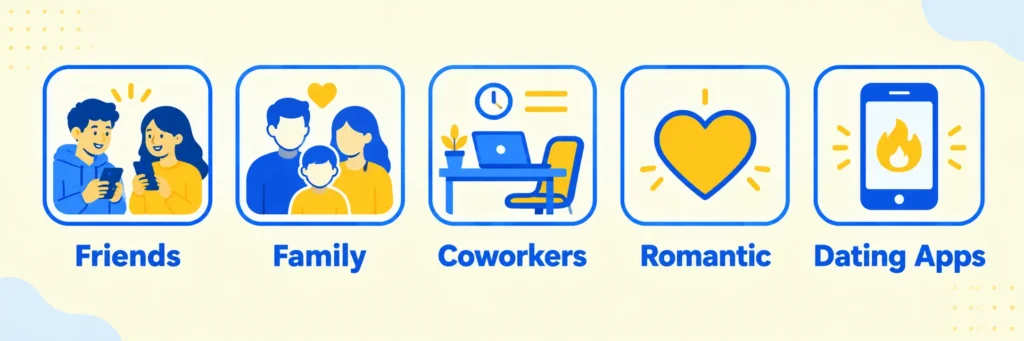
What Does Tuh Mean in Different Contexts?
The core meaning stays the same across relationships. What changes is how much attitude is acceptable and whether it reads as playful or sharp.
Between Friends
This is where “tuh” shows up the most. Friends use it to call out an obvious lie, react to gossip, or mock a bad excuse. It reads as playful teasing most of the time.
Between Family Members
Usage drops off here, but it still happens between siblings or cousins close in age. With parents or older relatives, it can come across as disrespectful, so most people skip it.
Between Coworkers
“Tuh” doesn’t belong in work chats, even casual ones. It reads as dismissive, and that’s a risky tone to bring into a professional relationship.
In Romantic Conversations
On its own, “tuh” isn’t romantic. It’s more likely to show up when a partner is teasing you about something (“You forgot again? Tuh.”) than as a way to express affection.
On Dating Apps
Some people use it to react to a cheesy line or an obvious exaggeration, almost like flirty banter. Example: “I’m basically a chef.” “Tuh, sure you are.” It signals playful skepticism, not disinterest, as long as the conversation keeps going.
Tuh Meaning in Chat, WhatsApp, Instagram, TikTok & Social Media
The meaning of “tuh” doesn’t change from platform to platform. What shifts is how it’s used, since each app has its own conversation style.
| Platform | Meaning | Example |
|---|---|---|
| Chat/SMS | dismissive or doubtful reaction | “Tuh, sure Jan.” |
| same reaction, often with a group audience | “Tuh, we all know that’s not true 😂” | |
| comment reaction to a bold or funny claim | “Tuh, this caption is not it” | |
| TikTok | audio reaction paired with text captions | “the way she said ‘tuh’ and walked off 💀” |
| Snapchat | quick reply to a story or snap caption | “Tuh, you didn’t” |
| Discord | reacting to a claim in a server chat | “he said he’s undefeated, tuh” |
| Facebook Messenger | casual reaction between friends | “Tuh, no way that’s real” |
Tuh on TikTok
TikTok is where “tuh” gets the most attention, partly because people react to it as a spoken sound in videos, not just a written word. Comment sections use it constantly to react to bold statements in a video.
Tuh on Instagram and Snapchat
On both apps, it shows up in comments and replies more than in captions. It’s a quick, low-effort way to signal “I don’t believe that” without typing out a full sentence.
Background and Origin of Tuh
There’s no confirmed inventor or exact origin date for “tuh.” It comes from the same place as most reaction slang: a spoken sound that people started spelling out once texting and instant messaging took over daily communication.
The evolution likely followed this general path:
- Early online communication: chat rooms and forums normalized short, sound-based reactions
- Instant messaging: AIM and early SMS pushed people toward shorter, faster replies
- Text messaging: character limits and typing speed made single-word reactions common
- Social media: comment sections gave dismissive reactions a bigger, more visible audience
- Gaming and dating apps: fast back-and-forth chat kept short reaction words in heavy rotation
- Modern messaging: “tuh” now sits alongside similar sounds like “tch” and “pfft” as standard texting shorthand
Why Do People Use Tuh?
Tuh” packs a reaction into one syllable, which fits how people actually text.
- Saves time: faster to type than “I don’t believe that” or “that’s not true”
- Sounds casual: fits naturally into informal conversations
- Carries tone: does the work of an eye-roll without needing an emoji
- Feels familiar: signals you’re comfortable enough with someone to be blunt
- Softens bluntness: a short reaction can feel less harsh than a full sentence of disagreement
Is Tuh Rude, Friendly, Flirty, or Romantic?
“Tuh” doesn’t lock in one emotion by itself. The words around it, the punctuation, and any emoji do most of the work.
- Friendly/playful: “Tuh, you’re so dramatic 😂” reads as light teasing.
- Casual: “Tuh, whatever you say” is neutral skepticism, nothing heavy.
- Romantic: rare on its own, but can show up in flirty banter between partners who already tease each other.
- Flirty: “Tuh, sure you are 😏” pairs doubt with interest.
- Sarcastic: “Oh yeah, tuh, totally believe you” leans hard into mockery.
- Rude: “Tuh.” with a period and nothing else, sent in response to something sincere, can come across as cold or dismissive.
Compare “Tuh.” to “Tuh 😊” to “Tuh!” The period reads flat and blunt. The emoji softens it into a joke. The exclamation point adds surprise or excitement instead of doubt.
Common Misconceptions About Tuh
“Tuh always means someone is being rude.” Not true. Most uses are playful or teasing, especially between friends.
“Tuh is the same word as ‘tuah.'” These are different terms with separate origins. Confusing them changes the meaning entirely.
“Tuh only works as a negative reaction.” It’s mostly used for doubt or dismissal, but some people also use it for surprised agreement.
“Tuh has a hidden technical meaning.” There’s no established medical, scientific, or business definition. It’s slang, full stop.
“Tuh always signals the sender is upset.” Tone depends on context. A stretched-out “tuhhh” with a laughing emoji reads very differently from a flat “tuh.”
“Tuh means the same thing every time it’s used.” The base meaning (doubt or dismissal) stays consistent, but the intensity swings from lighthearted to genuinely annoyed.
Similar Terms & Alternatives to Tuh
| Term | Full Form | Main Difference |
|---|---|---|
| tch | none, phonetic sound | shorter, more of a single click sound than a syllable |
| pfft | none, phonetic sound | leans more mocking, often paired with laughter |
| smh | shaking my head | expresses disappointment, not doubt about a specific claim |
| as if | phrase, not slang | full phrase version of the same skepticism “tuh” conveys |
Tuh vs. Tch
Both are phonetic reaction sounds. “Tch” reads shorter and sharper, closer to a single click. “Tuh” carries slightly more weight and can stretch out (“tuhhh”) for emphasis.
Tuh vs. Pfft
“Pfft” leans more toward mockery or amusement, almost like stifled laughter. “Tuh” leans more toward flat disbelief or irritation, without the humor built in.
Tuh vs. SMH
“SMH” reacts to something disappointing or frustrating in general. “Tuh” reacts specifically to a claim or statement you don’t believe.
Tuh vs. Similar Terms
Tuh vs. “As If”
“As if” spells out the skepticism in full (“As if he’d actually show up”). “Tuh” compresses that same energy into one syllable, usually as a standalone reply.
Tuh vs. “Sure, Jan”
“Sure, Jan” is a meme-based sarcastic phrase aimed at someone being clearly wrong. “Tuh” is more general and doesn’t need a specific reference to work.
Tuh vs. “Yeah Right”
Both express doubt, but “yeah right” reads more direct and conversational. “Tuh” feels more like a gut reaction than a formed sentence.
How to Respond to Tuh
| Situation | Suggested Response |
|---|---|
| Friend | “Tuh yourself, it’s true 😂” |
| Coworker | (best to avoid using or responding to “tuh” in work chats) |
| Romantic partner | “Rude, but okay 😘” |
| Dating app | “Ouch, tough crowd 😏” |
| Classmate | “Fine, don’t believe me then” |
| Gamer | “Watch, I’ll prove it” |
| Professional contact | (respond with a normal, direct sentence instead) |
Casual Replies
- “Tuh yourself.”
- “It’s true though.”
- “Believe what you want.”
- “Watch me prove it.”
- “Rude, but fair.”
- “Say less.”
- “Whatever you say.”
Friendly Replies
- “Okay hater 😂”
- “I see how it is.”
- “You’ll see.”
- “Fine, don’t believe me.”
- “Noted, I’ll show you.”
Romantic or Flirty Replies
- “That hurt 😩”
- “Tough crowd.”
- “Guess I’ll just have to prove it.”
- “Rude, but I like you anyway.”
- “Ouch, okay.”
Professional Replies
- “I understand the hesitation, happy to explain further.”
- “Let me clarify what I meant.”
- “Fair point, here’s more context.”
- “I get why that sounds off, let me walk you through it.”
- “Totally understand the skepticism.”
Tuh in Dating and Online Conversations
“Tuh” can show up as flirty banter, but it doesn’t prove someone’s interested on its own. A single reaction word can’t carry that much meaning by itself.
What actually signals interest looks more like:
- Following up with more questions
- Starting conversations without being prompted
- Staying consistent over days or weeks
- Using emojis and playful language alongside the teasing
- Making and keeping plans
- Complimenting you directly
If “tuh” comes paired with these behaviors, it’s probably playful. If it comes alone with short, one-word replies overall, the conversation is likely just fading.
When Should You Use Tuh?
Good situations:
- Texting close friends
- Casual group chats
- Social media comments
- Gaming chat
- Informal banter with a dating match
- Reacting to memes or obviously exaggerated claims
Situations to avoid it:
- Formal business emails
- Job applications or interviews
- Legal or government communication
- Serious complaints
- Formal client messages
- Sensitive or emotional conversations
In formal settings, swap it for a direct sentence instead, like “I’m not sure that’s accurate” or “Can you clarify that?”
Does Tuh Have Other Meanings?
| Field | Meaning | Notes |
|---|---|---|
| Texting | dismissive/doubtful reaction | main established use |
| Medical | none | no recognized medical definition |
| Physics | none | no recognized scientific definition |
| Aviation | none | no recognized aviation definition |
| Technology | none | no recognized tech industry definition |
Outside of texting and casual speech, “tuh” doesn’t have a documented technical meaning in any of these fields.
Frequently Asked Questions
What does tuh mean in texting?
“Tuh” means a written scoff or dismissive sound. People use it to show doubt, annoyance, or disbelief about something someone just said.
What does tuh mean on WhatsApp?
It carries the same meaning as everywhere else: a doubtful or dismissive reaction. On WhatsApp it often shows up in group chats reacting to a claim someone just made.
What does tuh mean on Instagram?
On Instagram, “tuh” usually shows up in comments as a quick reaction to a bold caption or claim, signaling the commenter doesn’t quite believe it.
What does tuh mean on TikTok?
On TikTok, “tuh” appears in comments reacting to something said in a video, and sometimes describes the actual sound someone made on camera.
Is tuh flirty?
It can be, depending on the context. Paired with teasing and emojis, it can read as playful banter. Alone, it usually just signals doubt.
Is tuh rude?
It can come across that way, especially sent flat with a period and no other context. Paired with humor or emojis, it usually reads as playful instead.
Does tuh mean someone likes you?
Not by itself. It might show up in flirty teasing, but you’d need other signals, like follow-up questions and consistent effort, to know someone’s actually interested.
What is the difference between tuh and smh?
“Tuh” reacts to a specific claim you doubt. “Smh” (shaking my head) reacts more broadly to disappointment or frustration.
How should I respond to tuh?
A short, playful comeback usually works best with friends. In professional settings, skip the slang and respond with a clear, direct sentence instead.
Can tuh be used professionally?
No. It reads as dismissive and casual, which doesn’t fit formal or professional communication. Use a direct sentence instead.
Conclusion
“Tuh” is a written scoff that signals doubt, dismissal, or annoyance about something someone just said. It shows up most between friends, in comments, and in casual group chats.
Tone depends heavily on context: a flat “tuh.” reads differently than “tuhhh 😂” attached to an inside joke. When in doubt, match the energy of the person you’re replying to.
If you want a softer version of the same reaction, “tch” or “as if” both work as close alternatives. A quick, playful comeback is usually the safest way to respond.

Welcome to Meaning Haven, I’m Muhammad Talha, a content writer and SEO specialist passionate about simplifying word meanings and modern language.
I help readers understand meanings, explore trending slang, and communicate with clarity. My goal is to make language easy, relatable, and useful for everyone.
Let’s explore meanings together!