

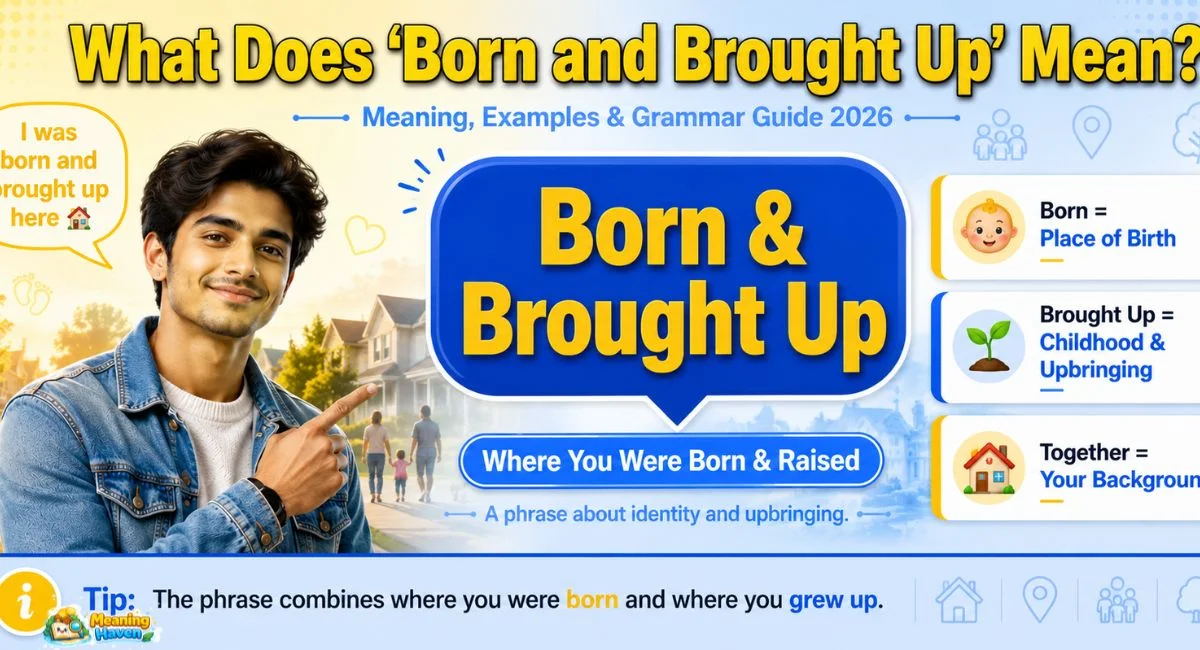
I was born and brought up in a small town, surrounded by family, familiar streets, and everyday routines that shaped who I am today. This simple phrase carries more meaning than it seems — it connects a person’s early life to the place that nurtured their personal identity and values.
Whether shared during an introduction, written in a bio, or mentioned in casual conversation, saying “I was born and brought up” offers a quick glimpse into someone’s background and upbringing. It’s a phrase rooted in both fact and emotion, blending the location of birth with the experiences of childhood years that followed — making it one of the most relatable ways to describe where someone truly comes from.
What Does “Born and Brought Up” Mean? (Quick Answer / Featured Snippet)
“Born and brought up” means that a person was born in a specific place and also spent their childhood growing up there. It combines two ideas: the location of someone’s birth and the location where they were raised during their early years.
For example: “She was born and brought up in Chicago, so she considers herself a true Midwesterner.”
This phrase is commonly used in introductions, biographies, and interviews to give a quick snapshot of someone’s background.
Breaking Down the Phrase – Born vs Brought Up
To fully understand the born and brought up meaning, it helps to look at each part of the phrase separately. Together, they form a complete picture of where someone comes from and how they grew up.
Meaning of “Born”
“Born” simply refers to the act of being born — the moment and location of someone’s birth. It’s a fact tied to a specific date and place, nothing more.
Example: “I was born in Los Angeles.”
This tells you only where the birth happened. It doesn’t say anything about where the person actually grew up.
Meaning of “Brought Up”
“Brought up” refers to how and where a person was raised — their upbringing, environment, family influence, and the years they spent growing up in a particular place.
Example: “I was brought up by my grandparents in a small town in Texas.”
This focuses on the experience of childhood and the environment that shaped someone’s values, habits, and personality.
Combined Meaning & Difference Between Both
When you combine the two, “born and brought up” tells a fuller story: it covers both the starting point (birth) and the formative years (upbringing). In many cases, both happen in the same place — but not always.
| Part | Refers To | Example |
| Born | Place/event of birth | “Born in Miami” |
| Brought Up | Place of upbringing | “Brought up in Atlanta” |
| Combined | Both birth and upbringing | “Born and brought up in Miami” |
Understanding this difference is especially useful when someone’s birthplace and childhood home aren’t the same — a situation we’ll explore later in this guide.
“Born and Brought Up” in Urdu/Hindi Translation
For readers who speak Urdu or Hindi, here’s how this phrase translates:
- Roman Urdu: “Paida hua aur wahin parwarish payi” (for males) or “Paida hui aur wahin parwarish payi” (for females)
- Urdu Script: “پیدا ہوا اور وہیں پرورش پائی”
- Hindi: “जन्म लिया और वहीं पले-बढ़े”
Example sentence with translation:
English: “I was born and brought up in New York.” Roman Urdu: “Main New York mein paida hua aur wahin parwarish payi.”
This translation is especially helpful for bilingual speakers who use both English and Urdu/Hindi in daily conversations, job interviews, or written bios.
Correct Grammar & Sentence Usage
Using “born and brought up” correctly requires attention to verb tense and sentence structure. Let’s go over the basics.
Basic Sentence Structure
The standard pattern follows this structure:
Subject + was/were + born and brought up + in + place
Examples:
- “I was born and brought up in San Francisco.”
- “She was born and brought up in a small village.”
- “They were born and brought up in different parts of the country.”
Notice that the verb “was” or “were” always comes before “born and brought up” — never after.
Alternative Phrasings/Forms
While “born and brought up” is common, English speakers also use these alternatives:
- “Born and raised” — slightly more casual and very common in American English
- “Grew up in” — focuses only on upbringing, not birth
- “Native of” — emphasizes origin, often used formally
- “Hails from” — a more literary or formal way to describe someone’s origin
Each of these carries a slightly different tone, which we’ll explore further later in this guide.
Common Grammar Mistakes to Avoid
Here are mistakes people often make with this phrase:
- Incorrect tense: Saying “I am born and brought up in Texas” instead of the correct “I was born and brought up in Texas.” Since birth and upbringing happened in the past, the past tense is required.
- Wrong preposition: Saying “born and brought up at New York” instead of “born and brought up in New York.” Use “in” for cities, states, and countries.
- Redundant repetition: Avoid awkward phrasing like “I was born in Dallas and brought up in Dallas and I’m from Dallas.” Simplify to: “I was born and brought up in Dallas.”
Real-Life Example Sentences
Seeing the phrase in different real-world contexts makes it easier to use naturally.
Personal Introduction (e.g., Interviews)
- “Hi, I’m Sarah. I was born and brought up in Denver, and I’ve always loved the outdoors.”
- “To tell you a bit about myself, I was born and brought up in a military family, so I moved around a lot.”
Formal/Professional Setting
- “John Smith was born and brought up in Boston, Massachusetts, where he developed an early interest in engineering.” (resume/bio style)
- “Our founder was born and brought up in the heart of Silicon Valley, surrounded by innovation from a young age.” (company bio)
Casual Conversation
- “Where are you from?” “I was born and brought up in Austin — born and bred Texan!”
- “You can definitely tell she was born and brought up near the beach. She’s always so relaxed.”
Why Is This Phrase So Commonly Used?
The phrase “born and brought up” appears often in everyday English — and for good reason.
Identity & Self-Expression
This phrase gives people a quick, meaningful way to express their identity. It connects who someone is today with where they come from, helping others understand their background in just a few words.
Cultural Significance
For many people, especially immigrants and individuals from diverse backgrounds living in the USA, this phrase carries deep cultural weight. It reflects a connection to community, heritage, and the values instilled during childhood.
Use in Interviews & Bios
Interviewers, hiring managers, and readers of biographies often want a quick sense of someone’s background. “Born and brought up” delivers that information efficiently, which is why it appears so frequently in introductions, LinkedIn profiles, and “About Me” sections.
Different Contexts of “Born and Brought Up”
Not everyone’s birthplace and childhood home are the same. Here’s how the phrase applies in different situations.
Same City/Place
This is the simplest case — someone was born and raised in the same location.
Example: “I was born and brought up in Philadelphia, and I still live here today.”
Different Places (Born in One, Raised in Another)
Sometimes a person is born in one location but spends their childhood somewhere else. In this case, it’s clearer to separate the two ideas.
Example: “I was born in India, but I was brought up in the United States.”
Here, “born in” and “brought up in” are used separately to avoid confusion, since combining them (“born and brought up in India and the United States”) would sound awkward.
Family/Generational Context
Military families, expat families, and immigrant families often experience this distinction. A child might be born during a parent’s deployment overseas but raised primarily in the USA, or born in the USA to immigrant parents and raised with strong ties to their parents’ home country.
Example: “He was born in Germany while his father was stationed there, but he was brought up in Ohio from the age of two.”
When to Use It & When NOT to Use It
When to use “born and brought up”:
- Self-introductions and casual conversations
- Personal bios, social media profiles, and “About Me” sections
- Storytelling or sharing personal background
- Interviews when asked about your background
When to avoid it:
- Legal or official documents — Use precise terms like “place of birth” and “current residence” instead, since these have specific legal meanings.
- When birthplace and upbringing differ significantly — Combining “born and brought up” can be confusing if the two locations are very different. Separate them for clarity (as shown in the section above).
- Highly formal academic or technical writing — Consider more neutral phrasing like “grew up in” or “originally from.”
Common Variations & Synonyms
If you want to mix up your language, here are common alternatives to “born and brought up,” along with their tone:
| Variation | Example Sentence | Tone |
| Born and raised | “I was born and raised in Florida.” | Casual, very common in American English |
| Grew up in | “I grew up in a small town in Ohio.” | Neutral, focuses on upbringing only |
| Native of | “She is a native of New Orleans.” | Formal |
| Hails from | “He hails from a quiet village in the countryside.” | Literary, slightly formal |
| Raised in | “Raised in Seattle, she developed a love for coffee culture.” | Neutral to formal |
| A [city] native | “As a Chicago native, he knows all the best pizza spots.” | Casual, identity-focused |
Choosing the right variation depends on your audience and the tone you want to set — casual conversations call for “born and raised,” while formal writing might favor “native of” or “hails from.”
FAQs About “Born and Brought Up”
What does it mean exactly?
“Born and brought up” describes a person’s place of birth and the location where they spent their childhood growing up. It’s often used to give a quick summary of someone’s background and roots.
Is “I am born and brought up” grammatically correct?
No. The correct form uses the past tense: “I was born and brought up.” Since “born and brought up” describes something that happened in the past, “am” (present tense) is incorrect.
Can birth place and upbringing place be different?
Yes, absolutely. Many people are born in one location and raised in another due to family relocation, military service, or immigration. In these cases, it’s clearer to say “I was born in [Place A] but brought up in [Place B]” rather than combining the phrase.
Is this phrase formal or informal?
“Born and brought up” is generally neutral to slightly informal. It works well in everyday conversation, casual bios, and interviews, but for highly formal documents (legal forms, official records), terms like “place of birth” and “place of residence” are more appropriate.
What’s another way to say this?
Common alternatives include “born and raised,” “grew up in,” “native of,” “hails from,” and “raised in.” Each has a slightly different tone — see the variations table above for guidance on when to use each one.
Final Thoughts
Understanding the born and brought up meaning helps you use this phrase confidently and correctly — whether you’re introducing yourself in an interview, writing a bio, or simply chatting with someone new. Remember to use the past tense, choose the right preposition, and separate “born” and “brought up” when they refer to different places. With these tips, you’ll be able to share your background clearly and naturally in any setting.

Welcome to Meaning Haven, I’m Muhammad Talha, a content writer and SEO specialist passionate about simplifying word meanings and modern language.
I help readers understand meanings, explore trending slang, and communicate with clarity. My goal is to make language easy, relatable, and useful for everyone.
Let’s explore meanings together!