 Skip to content

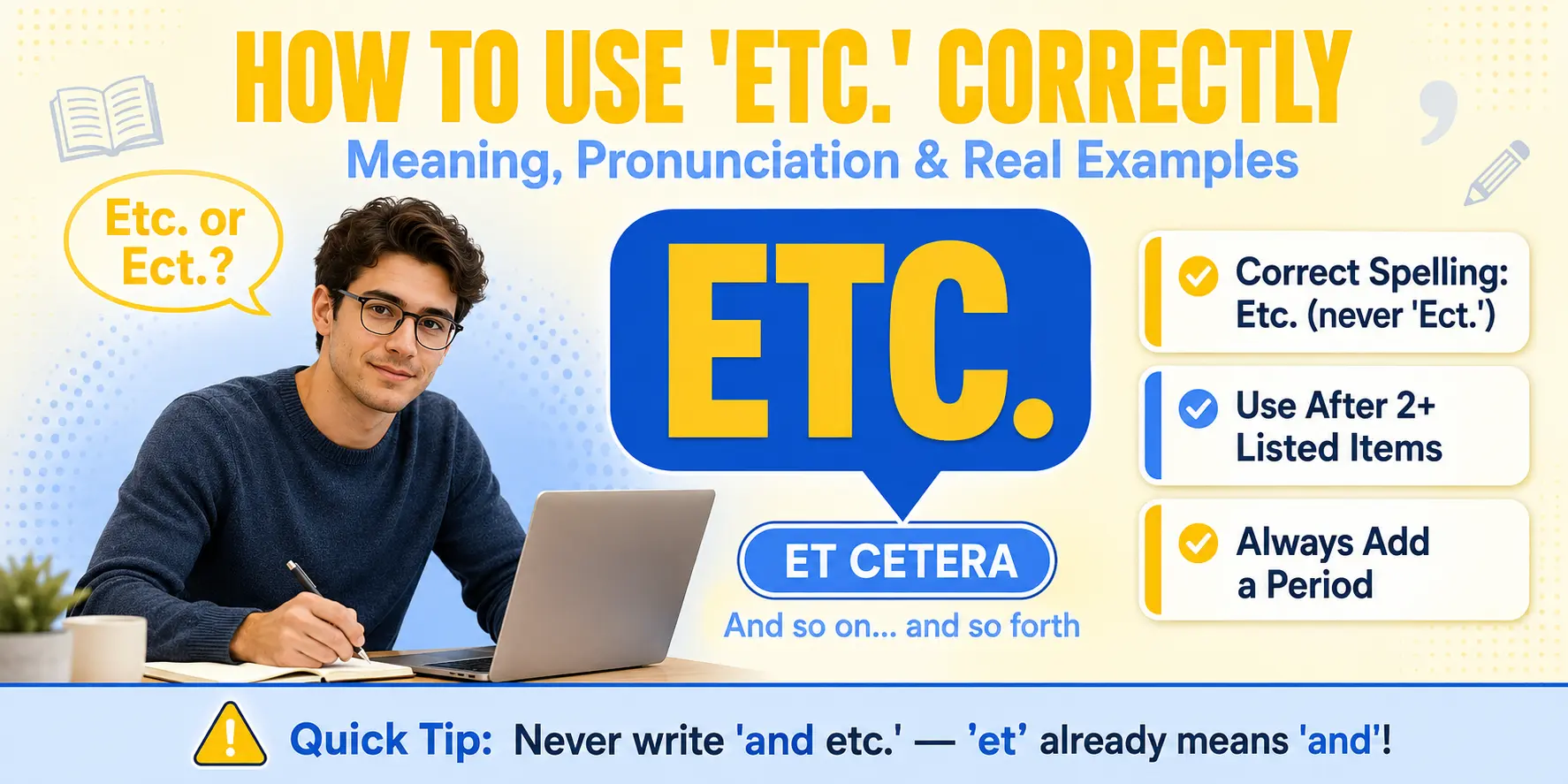
Ever gotten a text that ends with “etc” and wondered what it really means? You’re definitely not alone. This tiny word pops up everywhere, from group chats to Instagram captions to work emails. In simple terms, etc meaning in text points back to the Latin phrase et cetera, which translates to “and the rest.
People use it as a quick shortcut, so they don’t have to spell out every single item on a list. Whether you’re texting a friend about weekend plans or wrapping up a list of items in an email, etc. keeps things short, casual, and easy to read. Let’s break down exactly how it works.
What Does “Etc.” Mean?
“Etc.” meaning in plain English: it stands for et cetera, a Latin phrase meaning “and the rest” or “and so on.” It’s one of the most common Latin abbreviations still used in modern English.
Featured Snippet Answer: Etc. is an abbreviation for et cetera, a Latin phrase meaning “and the rest.” Writers use etc. to shorten a list of items when more examples exist but aren’t named. It always needs a period, since it’s an abbreviation, not a full word.
So next time someone asks “etc meaning” or “et cetera meaning,” you’ll have a quick, clear answer ready.
Does “Etc.” Have Any Other Meanings?
Good news here. Unlike slang terms such as TBH meaning (“to be honest”), the etc abbreviation only has one job. It always points back to “and so forth” or an unfinished list.
You won’t find hidden meanings in old texts or legal papers either. This foreign phrase has stayed remarkably consistent since it entered English writing centuries ago.
How to Pronounce “Et Cetera”
Getting the correct pronunciation right matters more than people think. Here’s a simple breakdown to help you say it confidently.
| Part | Sound |
| Et | “eht” |
| Cetera | “SET-er-uh” |
Common Mispronunciation to Avoid
Many people say “ex-cetera” instead of the correct pronunciation of et cetera. This happens because of assimilation, where the “t” sound blends with nearby sounds in casual speech. The right way is “et-SET-er-uh,” with a clear “t,” never an “x.”
“Etc.” vs “Ect.” — Which Spelling Is Correct?
Only one spelling is right in English writing: etc. The version “ect.” is one of the most common misspellings of etc. you’ll see online.
Why “Ect.” Is a Common Error
This mix-up happens because our brains sometimes swap letter order while typing fast. It’s a simple spelling slip, not a real alternative form.
Memory Trick for Correct Spelling
Remember: “et cetera” starts with “et,” so etc. must start with “et” too. Say the full Latin phrase slowly, and the correct spelling should follow naturally.
When to Use “Etc.” (With Examples)
Knowing when to use etc. matters just as much as spelling it correctly. Here are the main situations where this abbreviation fits.
Use It to Show an Incomplete List
Etc. works well after a list of items with at least two examples already given. For instance: “Bring pens, notebooks, etc.” This tells readers there’s more without naming everything.
Use It to Mean “And So On”
Sometimes etc. simply shows a pattern continues. “She collects stamps, coins, etc.” means “and so forth,” without listing every single item in her collection.
“Et Cetera” (Full Form) vs “Etc.” (Abbreviated)
Use the abbreviation etc. in casual and business writing. Save the full et cetera pronunciation and spelling for formal speeches or emphasis in academic writing.
Why Do People Use “Etc.” So Often?
This little word solves a real writing problem. It’s one of the easiest tools for writing efficiently without losing meaning.
Here’s why it’s everywhere:
- It saves time when typing or speaking
- It shortens long list examples into something readable
- It works across formal writing, informal writing, and everything between
- Nearly everyone understands it instantly, no explanation needed
This combination of speed and clarity explains why etc. survives in everyday English writing across generations.
The Tone and Context Behind “Etc.”
Etc. usually carries a neutral tone. It doesn’t sound rude or overly casual in most settings.
However, tone can shift depending on where you use it. In technical writing or academic writing, etc. can feel slightly informal if overused. In texts or social captions, it feels relaxed and friendly.
Sometimes etc. can accidentally sound dismissive too. Writing “family issues, work stress, etc.” might come across as brushing off someone’s problems, so context always matters.
When to Avoid Using “Etc.”
Etc. isn’t always the right call. Here’s when not to use etc., according to standard grammar rules.
- When you’ve already used it once in the same sentence
- When listing people — use “and others” instead, since etc. sounds cold for humans
- When list items have no clear connection — readers can’t guess what’s missing
- When you’ve named every possible item already
- After “e.g.,” “for example,” or “for instance” — this creates redundant wording
- After “and” — writing “and etc.” repeats the same meaning twice
A Quick Rule of Thumb
If your list feels complete or unrelated, skip etc. entirely. This is one of the simplest etc grammar rules to remember.
How to Punctuate “Etc.” Correctly
Getting punctuation rules right around etc. trips up plenty of writers. Let’s break down the punctuation with etc. step by step.
Comma Before Etc.
Standard comma usage places a comma before etc. when it follows a list. Example: “apples, oranges, bananas, etc.” This is one of the clearest list punctuation rules in English.
Period After Etc.
Etc. always needs a period after it, since it’s short for a longer phrase. This applies even mid-sentence, not just at the very end.
Etc. at the End of a Sentence
When etc. lands at the end, you only need one period, not two. The abbreviation’s own period does double duty as the sentence’s period too.
What About Semicolons and Parentheses?
A semicolon rarely pairs with etc. directly, since etc. usually closes a simple list, not two independent clauses. Parentheses can hold etc. when adding a quick aside, like “(shoes, bags, etc.),” inside a larger sentence.
“Etc.” in Everyday Communication
Etc. shows up across nearly every writing style today. Its core meaning stays the same, but usage shifts by platform and audience.
In Text Messages and Social Media
Casual settings welcome etc. freely, right alongside abbreviations like TBH meaning “to be honest.” A text like “grabbing snacks, drinks, etc.” feels completely natural among friends.
In Emails and Business Writing
Business writing still allows etc., though sparingly. Overusing it can make professional emails feel rushed or incomplete.
In School and Workplace Writing
Teachers and managers generally accept etc. in informal notes. However, academic writing and formal reports often prefer full, spelled-out lists instead.
Formal vs. Informal Tone Differences
Formal writing uses etc. carefully and rarely repeats it. Informal writing allows more freedom, since the tone is naturally relaxed.
“Etc.” on Instagram, Snapchat, TikTok, and X
Short-form platforms love etc. because space is limited. A caption like “Beach day, sunshine, good vibes, etc. ☀️” packs meaning into few words, which fits perfectly with quick, scroll-friendly content.
Common Misunderstandings About “Etc.”
A few myths about etc. keep circulating online. Clearing these up will sharpen your English grammar instantly.
- Thinking etc. can replace naming people — it can’t, since it feels impersonal
- Assuming etc. needs three or more items — actually, two items are enough
- Confusing etc. with mispronounced versions — like “ex-cetera” instead of the real form
Examples of “Etc.” in Real Sentences
Seeing real sentence examples helps everything click. Here are etc. sentence examples across different settings.
Casual conversation:
“Pack your swimsuit, sunscreen, etc. for the beach trip!”
Friendly text exchange:
Sam: “What’s the party like?” Jess: “Music, snacks, games, etc. Come through!”
Professional email:
“The proposal covers budget, timeline, staffing, etc.”
Workplace chat:
“Meeting agenda includes sales, marketing, hiring, etc.”
Each of these examples of etc. in sentences shows an open-ended list. Readers instantly understand more items exist without needing every one spelled out.
How to Respond When Someone Uses “Etc.” in a Message
Most of the time, you can simply move on with the conversation. Etc. usually signals the list isn’t crucial to name in full.
However, ask for clarification if the missing items actually matter. For example, if a coworker writes “bring reports, files, etc.” for a big meeting, it’s fair to ask exactly what “etc.” includes.
“Etc.” vs Similar Abbreviations
Confusing etc. with other Latin abbreviation rules is common. Here’s a clear comparison table to sort things out.
| Abbreviation | Full Latin Form | Meaning | Best Use Case |
| Etc. | Et cetera | “And so on” | Closing an incomplete list of items |
| E.g. | Exempli gratia | “For example” | Introducing specific examples in a sentence |
| I.e. | Id est | “That is” | Clarifying or restating a point |
| Et al. | Et alii | “And others” | Referring to people, especially in academic writing |
Etc. vs E.g.
E.g. introduces examples, while etc. closes out a list. They serve opposite roles in sentence structure.
Etc. vs I.e.
I.e. restates or clarifies something already mentioned. Etc. instead adds unnamed items to a list, showing there’s more of the same category.
Etc. vs Et Al.
Et al. (short for et alii) replaces etc. when listing people, especially authors in citations. Never use etc. for humans; use et al. instead.
Alternatives to “Etc.”
Sometimes a different phrase fits better than etc. These options boost writing style and add variety.
Casual Alternatives
- “and stuff”
- “and more”
- “and so on”
These work well in relaxed conversations, texts, or social captions.
Professional Alternatives
- “among others”
- “and the like”
- “and similar items”
These sound polished for formal writing without losing the original meaning.
Common Mistakes to Avoid With “Etc.”
A handful of small errors show up again and again. Fixing these will instantly improve your writing clarity.
Writing “And Etc.”
This is redundant wording, since “et” already means “and.” Simply drop the extra “and” and write etc. alone.
Using Etc. Without a Real List
Etc. only makes sense after use after two or more items. Using it after just one example leaves readers confused about the pattern.
Overusing Etc. in Formal Writing
Too much etc. can make technical writing or reports feel vague. Balance it with specific details whenever precision truly matters.
Using Etc. After a Single Item
Similar to the mistake above, a single example doesn’t establish a clear pattern. Readers need at least two items from the same category before etc. makes sense.
Forgetting Context Clues
If your list of items jumps between unrelated topics, etc. won’t work well. Readers can’t guess what’s missing, so spelling things out is safer here.
Why “Etc.” Has Stuck Around for So Long
Latin abbreviations like etc., e.g., and et al. have survived for centuries in English writing. They offer a shortcut that no modern replacement has fully matched.
Even in today’s texting culture, etc. remains just as useful as ever. It proves that good proofreading habits and classic grammar rules never really go out of style.
Frequently Asked Questions About “Etc.”
What is “etc.” an abbreviation of? It’s short for the Latin phrase et cetera, meaning “and the rest.”
What does “et cetera” mean? It means “and other things” or “and so forth,” used to close an incomplete list.
When should you use etc.? Use it after at least two listed items when more exist but aren’t named, following standard list writing rules.
Is “and etc.” correct? No. Since “et” already means “and,” writing “and etc.” repeats the word and creates redundant wording.
Does etc. always need a period? Yes, it’s an abbreviation and requires a period, even at the very end of a sentence.
Is etc. formal or informal? It works in both, though formal writing should use it sparingly and informal writing allows more freedom.
Can etc. be used in professional emails? Yes, as long as the list of items is clear and it isn’t repeated too often in the same message.
Key Takeaways:
Using “Etc.” Correctly and Concisely
Etc. is a small word that carries real weight in good English writing. Spell it correctly, punctuate it properly, and use it only when a list truly stays open-ended.
Skip it when listing people, after phrases like “for example,” or when your list is already complete. Follow these simple grammar rules, and etc. will always work in your favor.

Welcome to Meaning Haven, I’m Muhammad Talha, a content writer and SEO specialist passionate about simplifying word meanings and modern language.
I help readers understand meanings, explore trending slang, and communicate with clarity. My goal is to make language easy, relatable, and useful for everyone.
Let’s explore meanings together!