 Skip to content

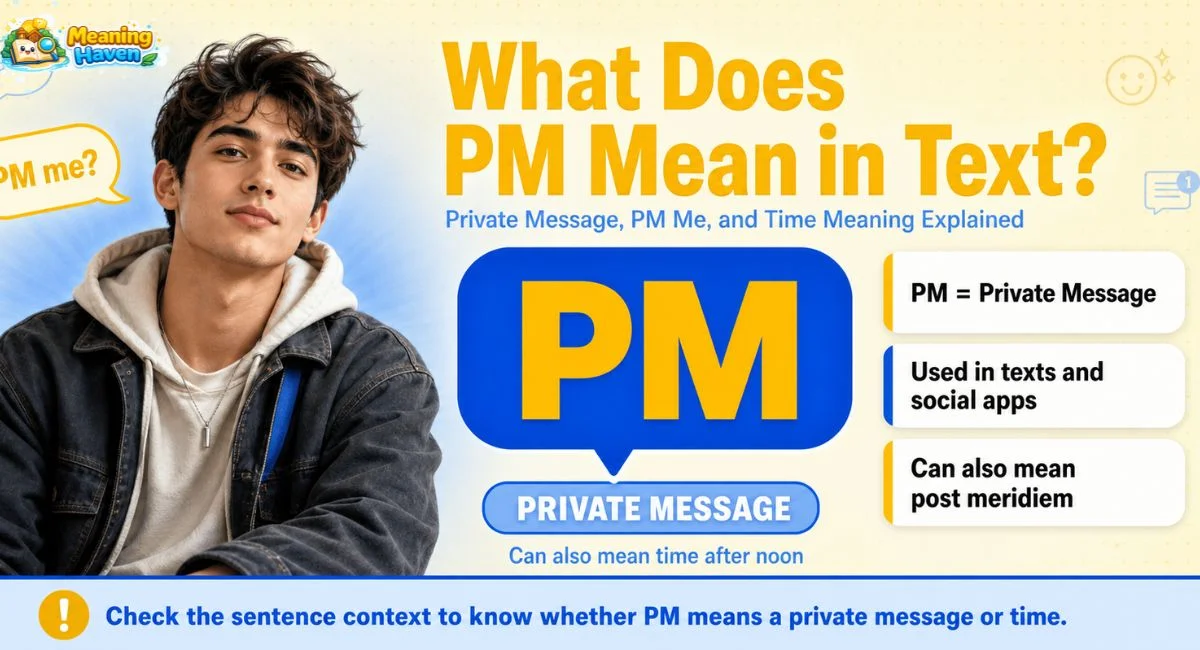
If you have ever seen someone write “PM me” in a text, comment, or social media post, you may have paused and wondered what it means. That is a very common problem. Many readers get confused because PM can mean different things in different situations. In one message, it means private message. In another, it can mean post meridiem, which refers to time after noon. This can be frustrating for beginner internet users, non-native English readers, older users, and anyone who does not use chat slang often.
From reviewing how people actually use this term across texts, social media posts, forums, and online groups, the most common meaning is clear: in texting, PM usually means private message. Still, context is what helps you understand it correctly. That is why this guide explains the term in simple English, with real examples and common situations like “PM me,” “PM for price,” and time-related uses, so readers can quickly understand what the sender really means.
Quick Answer
- PM in text usually means private message.
- It can also mean post meridiem when talking about time.
- The meaning depends on the context.
What Does PM Mean in Text Messaging?
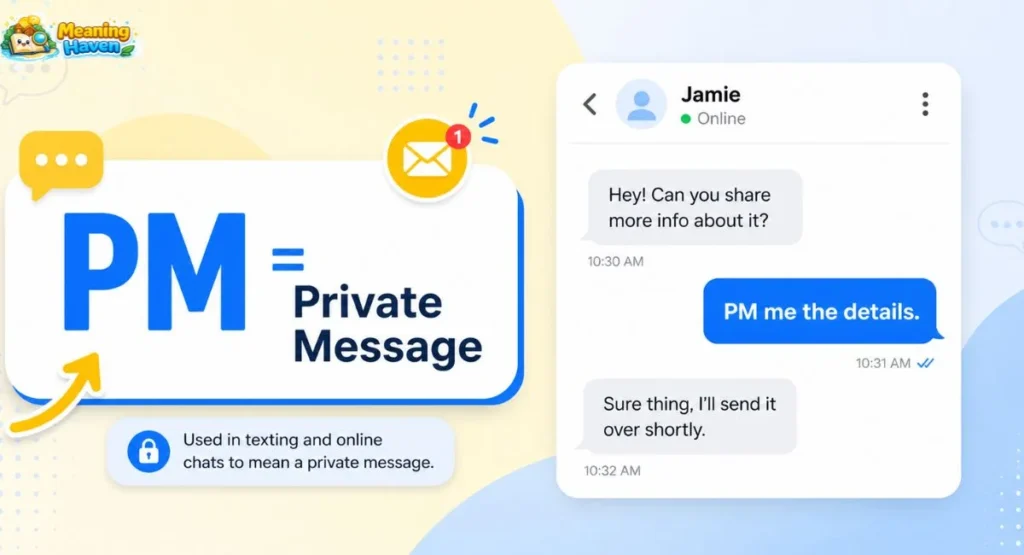
In text messaging, PM usually means private message.
A private message is a message sent directly to one person. It is meant to be private and is not posted publicly.
People use PM when they want to:
- share details in private
- ask something personal
- continue a conversation away from public comments
- send contact information safely
Simple examples
- “PM me your number.”
- “I will PM you the address.”
- “Can you PM me the full details?”
In all these examples, PM means private message.
So, if you are asking what does PM mean in text, the main answer is simple:
PM means private message.
Why Do People Use PM Instead of Public Replies?
People use PM because it is more private.
Sometimes a person does not want to post personal details in a comment section. Sometimes they want a one-to-one talk. In both cases, PM is useful.
Here are common reasons people use PM:
- to protect private information
- to avoid a long public conversation
- to talk in a more personal way
- to discuss price, address, or contact details
For example:
- “Don’t post your number here. PM me.”
- “If you are interested, PM me.”
This is why the term PM in text is very common on social media, forums, and chat apps.
PM Meaning in Different Platforms
The meaning of PM stays almost the same on most platforms. It still means private message. But the way people use it can change a little.
This is helpful for users who see PM on Snapchat, Facebook, Instagram, forums, or chat groups and want a quick answer.
PM Meaning on Social Media
On social media, people often use PM when they want to continue a public conversation in private.
Examples:
- “PM me for more info.”
- “Please PM me if you want to buy it.”
- “PM me the screenshot.”
This is common on Facebook, Instagram, and similar platforms.
PM Meaning in Online Forums
On forums, PM is a common term for private messaging.
Examples:
- “I sent you a PM.”
- “Please check your PM.”
- “PM me the link.”
PM Meaning in Chat Apps
In chat apps, PM usually means private message, but sometimes people use more modern terms like DM or simply message me.
Examples:
- “PM me when you are free.”
- “I will PM you later.”
So, across most apps, the PM meaning in text messaging is still the same.
What Does PM Mean on Snapchat?
On Snapchat, PM usually means private message. It refers to a one-to-one private conversation instead of a public reply or group chat.
Example:
- “PM me on Snapchat.”
- “I will send you a PM.”
This meaning is very similar on other social apps too.
PM vs DM – Are They the Same?
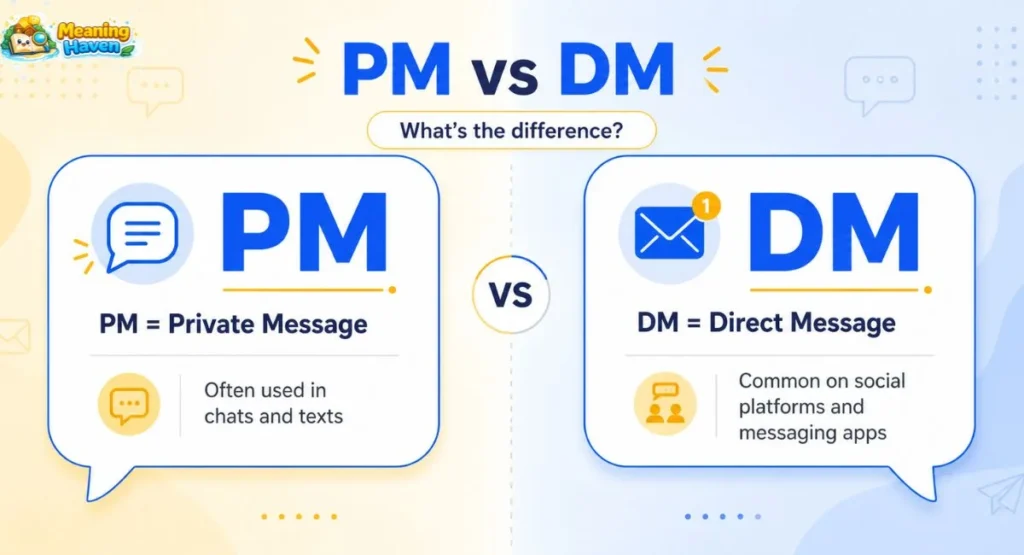
Many people ask this question: Is PM the same as DM?
The short answer is: almost yes.
Both PM and DM refer to a private one-to-one message. But people may use them a little differently.
PM
- means private message
- is common on forums, older websites, and general online talk
- sounds a little broader
DM
- means direct message
- is often used on modern social media platforms
- is often used on Instagram, X, TikTok, and similar apps
Simple difference
- PM me = send me a private message
- DM me = send me a direct message
In daily use, many people treat them as the same thing.
This section is useful for younger users and social media users because many apps now use DM more often than PM.
| Term | Full Form | Meaning | Example |
|---|---|---|---|
| PM | Private Message | A private chat with one person | PM me the details |
| DM | Direct Message | A private message on social platforms | DM me on Instagram |
| PM | Post Meridiem | Time after noon | The meeting is at 5 PM |
Other Meanings of PM in Text
Even though PM usually means private message, it can have other meanings too.
That is why context matters.
PM as Time (Post-Meridiem)
In time, PM means post meridiem. It refers to the time after 12 noon.
Examples:
- 3 PM
- 6:30 PM
- 9 PM
Here, PM has nothing to do with texting or private messages.
Example
- “The meeting starts at 4 PM.”
In this sentence, PM clearly means time.
So if you are wondering what does PM mean in text, always check the sentence first. It may mean private message or post meridiem.
Does PM Mean Private Message or Personal Message?
In most texting and social media contexts, PM means private message. Some people also use it to mean personal message, but private message is the more common meaning.
That is why, if someone says “PM me”, they usually want you to send them a message in private.
How to Know Which PM Meaning Is Being Used
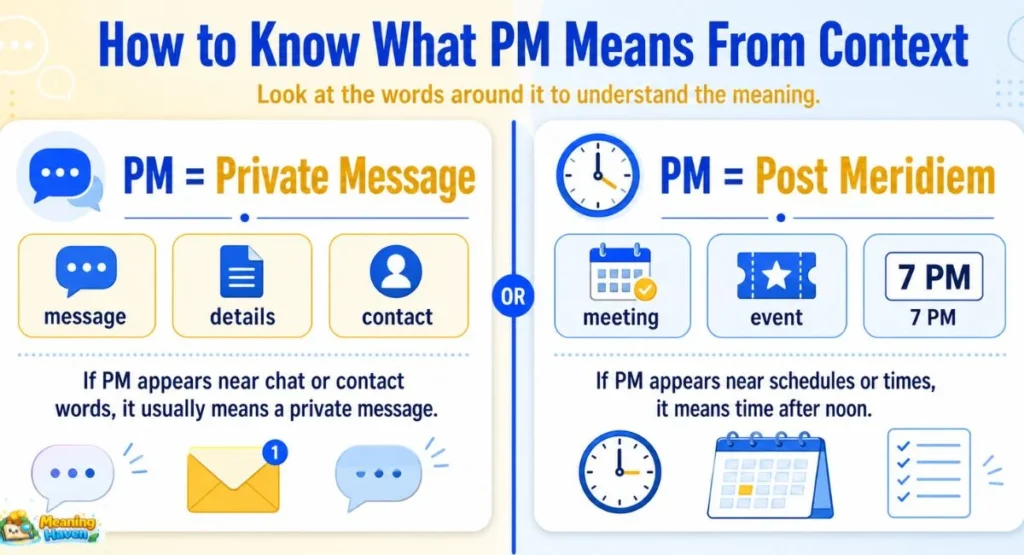
The easiest way to understand PM is to look at the full sentence.
This is especially helpful for beginner users, non-native English readers, and anyone who sees PM without context.
Ask yourself:
- Is the person talking about chatting?
- Is the person asking for private details?
- Is the person talking about a time of day?
If the sentence is about messaging
Then PM means private message.
Example:
- “PM me the details.”
If the sentence is about time
Then PM means post meridiem.
Example:
- “The class starts at 2 PM.”
Quick tip
If the sentence includes words like:
- send
- message
- details
- contact
- chat
Then PM probably means private message.
If the sentence includes:
- meeting
- class
- dinner
- time
- event
Then PM probably means time.
| If the sentence talks about… | PM usually means… | Example |
|---|---|---|
| chatting, message, contact, details | Private Message | PM me your number |
| meeting, event, class, dinner, time | Post Meridiem | The event starts at 7 PM |
Common PM Examples in Real Conversations
Examples make the meaning easier to understand.
Here are some common examples of PM in text:
Private message meaning
- “PM me your email.”
- “Can you PM me the address?”
- “I will PM you after work.”
- “She told me to PM her for details.”
- “Please PM me if you are interested.”
Time meaning
- “Let’s meet at 5 PM.”
- “The movie starts at 8 PM.”
- “I will call you at 7 PM.”
These examples show how the meaning changes with context.
Extra Common PM Examples
Here are a few more examples people often use:
- “Check your PMs.”
- “I sent you a PM.”
- “Please PM me for the full details.”
- “PM me if you want the link.”
These examples also show that PM usually means private message.
PM Meaning in Buying, Selling, and Online Groups
This section is helpful for older users, marketplace users, and people in community groups.
In business or selling groups, PM is very common.
Sellers often say:
- “PM for price.”
- “PM me for availability.”
- “PM to order.”
- “PM if interested.”
In these cases, PM means private message.
People use it because they may not want to post prices or details in public. They may also want to talk directly with a buyer.
Example
- “If you want to buy this item, PM me.”
This means the seller wants you to contact them privately.
So, in buying and selling spaces, the PM meaning in text is still private message.
Is PM Formal or Casual?
PM is usually casual. It is common in texting, social media, chat apps, and forums.
It is fine in:
- casual messages
- online comments
- community groups
- social media chats
But it may sound too casual in very formal writing.
For example, in a formal email, it may be better to say:
- Please send me a private message
- Please contact me directly
Still, in normal online use, PM is clear and easy to understand.
Why PM Became So Popular Online
As online chat became more common, short forms like PM became popular because they were quick to type.
PM is short, easy to use, and useful when people want privacy.
That is why the phrase PM me became very common online.
PM Etiquette – How to Use It Politely
Using PM is easy, but it is still good to be polite.
Here are a few simple tips:
- do not force people to reply
- be respectful in private chats
- do not send unwanted personal messages
- ask before sending sensitive details
- keep your message clear and short
Polite examples
- “Please PM me if you are comfortable sharing more details.”
- “You can PM me if you want to discuss this privately.”
Good PM etiquette helps the conversation stay respectful.
PM Meaning in Relationships and Friendships
In personal chats, PM can sound friendly and direct.
Friends may say:
- “PM me when you are free.”
- “If you need help, PM me.”
- “PM me later.”
In these cases, PM means a private and personal conversation.
It is often used when someone wants to move a conversation from a group or public space into a private chat.
Common Misunderstandings About PM
Some people get confused because PM has more than one meaning.
Here are the most common misunderstandings:
1. Thinking PM always means time
This is not true. In texting, PM usually means private message.
2. Thinking PM and DM are completely different
They are very similar in most situations.
3. Thinking PM is only used on one app
This is not true. People use PM on many platforms.
4. Thinking PM sounds rude
It is not rude by itself. Tone and context matter.
So, if you see PM in a message, do not guess too fast. Read the full sentence first.
Custom Example Sentences Using PM
Here are more easy examples to help you understand the term better:
- “PM me your location.”
- “He said he would PM me after dinner.”
- “Please PM me for the full price list.”
- “I got a PM from the group admin.”
- “The event starts at 6 PM.”
- “Can you PM me the file?”
- “She asked me to PM her instead of commenting.”
These examples show both common meanings of PM in simple English.
A Quick Note About PM in Time
PM can also mean post meridiem, which refers to time after noon.
Example:
- “The event starts at 7 PM.”
A small tip: 12 a.m. and 12 p.m. can confuse some readers, so midnight and noon are often clearer.
Key Takeaways
- PM in text usually means private message
- PM me means send me a private message
- PM for price means ask privately for the price
- PM can also mean post meridiem in time-related sentences
- The full sentence helps you understand the correct meaning
Frequently Asked Questions
What does PM mean in text slang?
In text slang, PM usually means private message. It is used when someone wants a private chat.
What does PM me mean?
PM me means send me a private message. The person wants to continue the conversation in private.
What does PM for price mean?
PM for price means the seller wants you to ask for the price in a private message instead of posting about it publicly.
Is PM the same as DM?
In most cases, yes. PM means private message, and DM means direct message. People often use them in a similar way.
Can PM mean time?
Yes. In time, PM means post meridiem, which means after noon.
What does PM mean on Snapchat?
On Snapchat, PM usually means private message.
Is it rude to say “PM me”?
No. It is not rude by itself. It is a normal phrase in online communication. But the tone should stay polite.
Should I use PM in professional emails?
You can, but in formal emails, it is often better to use full words like private message or contact me directly.
Conclusion (Final Thoughts)
In real online communication, small terms like PM can confuse people more than expected because the meaning changes with context. After looking at how the term is commonly used in texting, social media, forums, and online selling groups, the clearest takeaway is simple: PM usually means private message, but in time-related sentences it means post meridiem. The best way to understand it correctly is to read the full sentence and look at the situation. If someone says “PM me the details,” they want a private message. If someone says “The event starts at 7 PM,” they are talking about time. That is why the most accurate and practical answer is this: PM usually means private message in text, and the context tells you when it means something else.

Welcome to Meaning Haven, I’m Muhammad Talha, a content writer and SEO specialist passionate about simplifying word meanings and modern language.
I help readers understand meanings, explore trending slang, and communicate with clarity. My goal is to make language easy, relatable, and useful for everyone.
Let’s explore meanings together!