 Skip to content

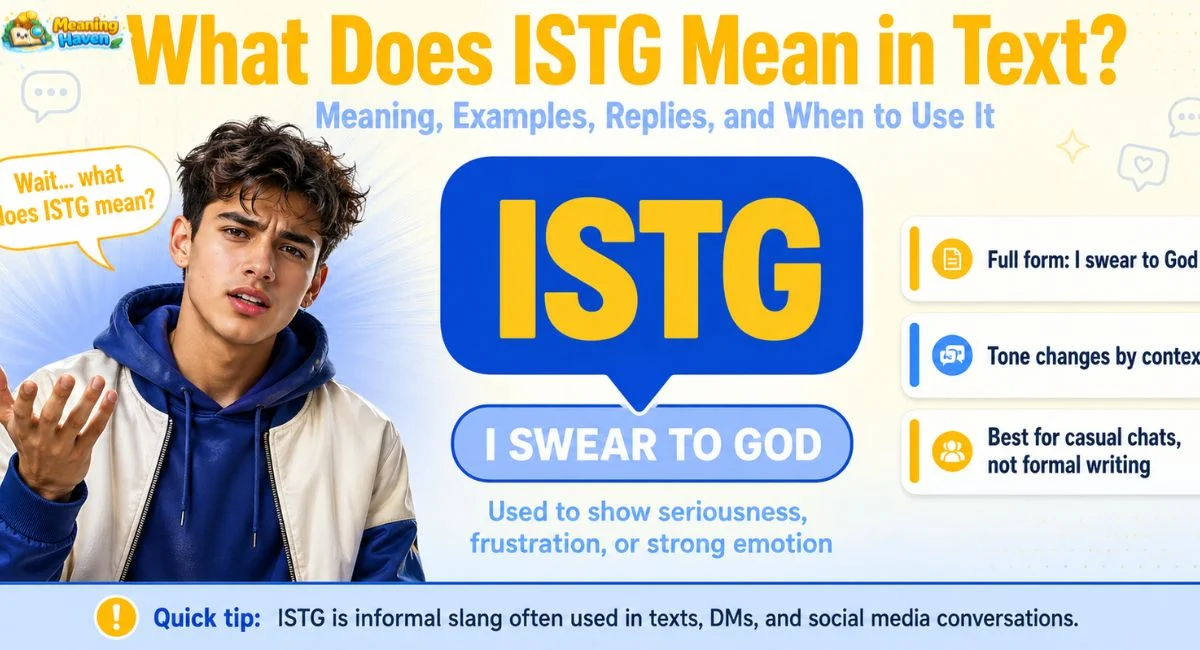
If you searched what does ISTG mean in text, there is a good chance you saw it in a message and felt confused right away. Maybe a friend sent it during an argument, maybe you noticed it in a TikTok comment, or maybe someone used it in a chat and the tone was hard to read. That is the real pain point with slang like ISTG. The phrase may look simple, but the meaning is not always obvious from the letters alone. Many people do not just want the full form. They want to know whether the sender is being serious, dramatic, frustrated, or joking.
After analyzing how top articles explain the term and how it is used in everyday digital conversations, one thing stands out clearly: users want more than a basic definition. They want a quick answer, real examples, and help understanding the tone behind the message. That is why this guide does more than explain the acronym. It breaks down what ISTG means in text, how people use it in different situations, whether it can sound rude or offensive, how to reply to it, and when it may be better not to use it at all.
Quick Answer
- ISTG means “I swear to God.”
- People use it in text to show seriousness, frustration, or strong emotion.
- It is informal slang and is best used in casual chats, not formal writing.
What Does ISTG Mean in Text?
The meaning is simple.
ISTG stands for “I swear to God.”
It is mostly used in casual digital conversations. You will often see it in:
- text messages
- DMs
- group chats
- comments
- social media posts
People use it when they want to:
- show they are serious
- prove they are telling the truth
- express frustration
- make a point stronger
- react with strong emotion
Examples:
- “ISTG I sent you the file already.”
- “ISTG this app is so annoying.”
- “ISTG that was the best meal ever.”
ISTG Full Form
The full form of ISTG is:
I = I
S = Swear
T = To
G = God
That is the full meaning. But in texting, people usually care more about the tone than the full form itself.
What Does ISTG Mean in Texting?
In texting, ISTG usually means the person wants their message to sound stronger.
It can show:
- honesty
- frustration
- excitement
- stress
- emphasis
That is why the same slang term can feel different from one message to another.
For example:
- “ISTG I am not lying.” = honesty
- “ISTG this is so annoying.” = frustration
- “ISTG that was amazing.” = strong reaction
Origin of ISTG: Where Did It Come From?
ISTG comes from the phrase “I swear to God.” As texting and online chatting became more common, people started shortening longer phrases to save time.
That is how ISTG became a popular acronym in informal digital conversations.
Today, it is widely used in texts, chats, and social media.
ISTG Meaning in Different Contexts
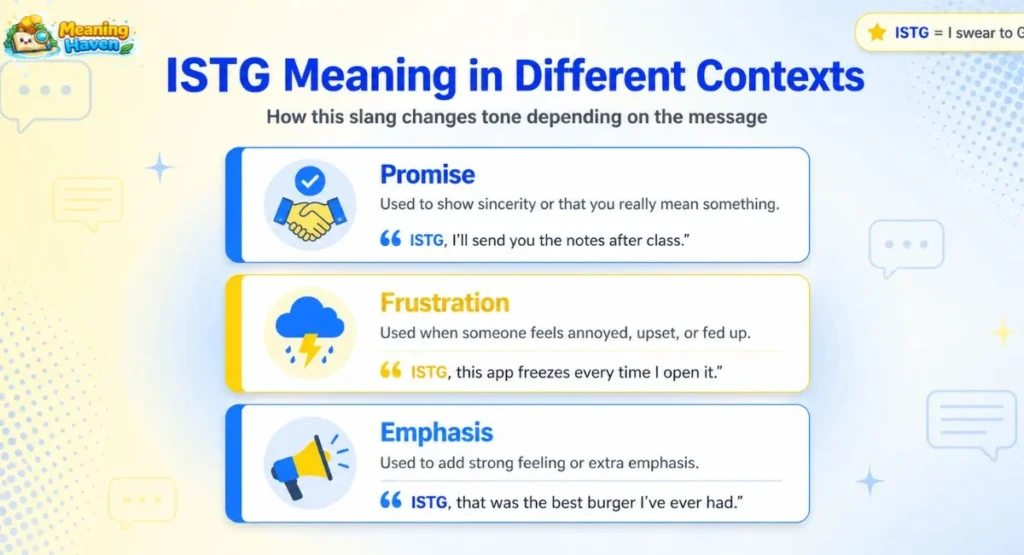
The core meaning stays the same, but the tone changes with the context.
1. ISTG as a Promise
Sometimes people use ISTG to show they are being honest.
Examples:
- “ISTG I did not lie to you.”
- “ISTG I was at home all day.”
- “ISTG that is what happened.”
Here, the speaker wants to be believed.
2. ISTG as Frustration
People also use it when they feel upset or annoyed.
Examples:
- “ISTG this phone keeps freezing.”
- “ISTG if the internet stops again, I’m done.”
- “ISTG nobody listens to me.”
Here, ISTG adds emotional pressure.
3. ISTG as Emphasis
Sometimes ISTG is used to make a sentence feel stronger.
Examples:
- “ISTG this show is amazing.”
- “ISTG that was the funniest thing ever.”
- “ISTG you need to try this.”
In this case, it adds strong feeling.
How Is ISTG Used in Conversations?
In real conversations, ISTG is often used:
- to sound serious
- to defend yourself
- to express anger
- to be dramatic
- to react strongly
Example:
Friend 1: “Did you really finish the project?”
Friend 2: “ISTG I did.”
Another example:
Friend 1: “Why are you so mad?”
Friend 2: “ISTG this day has been terrible.”
The meaning depends on the topic, tone, and sentence around it.
The Importance of Context When Using ISTG
Context matters a lot.
The same acronym can mean slightly different things in different situations.
For example:
- “ISTG I’m telling the truth” = serious
- “ISTG this is so annoying” = frustration
- “ISTG that was iconic” = strong praise
- “ISTG you are too funny” = playful or dramatic
That is why people often search this phrase after seeing it in a real message. They do not only want the full form. They want to know what the sender really meant.
Quick Context Table for ISTG
| Example | Meaning | Tone |
| “ISTG I sent it already.” | I am telling the truth | Serious |
| “ISTG this app is so annoying.” | I am frustrated | Angry or annoyed |
| “ISTG that was amazing.” | I feel very strongly about it | Excited |
| “ISTG if this happens again…” | Strong warning or emotion | Intense |
Is ISTG Formal or Informal?
ISTG is informal.
It works best in casual communication such as:
- text messages
- social media
- DMs
- online chats
- group conversations
It is not a good choice for:
- work emails
- school assignments
- client messages
- professional writing
- formal communication
If the setting is serious or professional, avoid ISTG.
Is ISTG Rude?
Not always.
In many cases, ISTG is just casual slang. But it can sound rude, intense, or disrespectful depending on the tone and the audience.
It may sound rude when:
- the sentence is angry
- the message feels aggressive
- the reader dislikes strong slang
- the phrase feels too intense for the situation
So the safest answer is this:
ISTG is not always rude, but it can sound harsh in the wrong context.
Is ISTG Offensive or Disrespectful?
This depends on the person and the situation.
Some people think ISTG is normal internet slang. Others may find it disrespectful because it includes the word “God.”
So while it is not always offensive, it can feel sensitive to:
- religious readers
- older audiences
- formal readers
- people who dislike strong language
If you are unsure, it is safer to use a softer phrase.
Is ISTG Religious?
The phrase includes the word “God.” Many people use it casually as slang, not as a religious statement.
Still, some people may find it sensitive. That is why audience and context matter.
If you are unsure, you can use:
- “I promise”
- “I’m serious”
- “Honestly”
- “I really mean it”
How Teenagers and Adults Use ISTG Differently
ISTG is especially common in internet slang and youth-focused online spaces, but people of different ages may use it casually online.
Teen Usage
Teenagers often use ISTG in a fast, expressive, and emotional way.
Examples:
- “ISTG this song is my whole personality.”
- “ISTG I cannot deal with this.”
- “ISTG you better not tell anyone.”
Teen usage can sound dramatic, playful, or intense.
Adult Usage
Adults may also use ISTG in casual digital conversations. When they do, it often sounds more direct.
Examples:
- “ISTG I already explained this.”
- “ISTG I’m being honest.”
- “ISTG this week has been exhausting.”
The tone may be more serious depending on the context.
Common Examples of ISTG in Text Messages
Here are some simple examples of ISTG in text:
- “ISTG I forgot about the meeting.”
- “ISTG I was just about to call you.”
- “ISTG this is the worst traffic ever.”
- “ISTG that meal was perfect.”
- “ISTG I am not joking.”
- “ISTG if this happens again, I’m leaving.”
- “ISTG you always make me laugh.”
These examples show how the phrase can fit many moods.
What Does ISTG Mean on Snapchat, TikTok, and Instagram?
The meaning usually stays the same across casual online conversations. It still means “I swear to God.”
But the style of use can change a little by platform.
On Snapchat
It often appears in fast, personal chats. People use it for quick reactions and direct emotion.
Example:
- “ISTG I sent that snap already.”
On TikTok
It may appear in captions, comments, or funny posts. It often sounds dramatic, exaggerated, or emotional.
Example:
- “ISTG this trend is everywhere.”
On Instagram
It may show up in DMs, comment sections, or story replies. It is often used for strong reactions.
Example:
- “ISTG this outfit looks perfect.”
Should You Use ISTG on Social Media?
Yes, but only in the right setting.
ISTG fits casual social media use because it is short, expressive, and easy to understand in context.
It works best in:
- captions
- comments
- replies
- private chats
- story reactions
But you should still think about your audience. A casual post is different from a brand page, formal page, or public statement.
How to Reply to ISTG
If someone sends you ISTG, your reply should match their tone.
If they sound serious
- “Okay, I believe you.”
- “Got it.”
- “That makes sense.”
If they sound annoyed
- “What happened?”
- “That sounds frustrating.”
- “Yeah, I get it.”
If they sound funny or dramatic
- “Calm down.”
- “You are so dramatic.”
- “Lol, I know.”
If they sound upset
- “I understand.”
- “That really sounds stressful.”
- “Want to talk about it?”
This is one of the most useful things to know, because many people search the term after receiving it from someone else.
When Not to Use ISTG
ISTG is common in casual chats. But it is not right for every situation.
You should avoid ISTG in:
- work emails
- school assignments
- business messages
- client communication
- formal writing
- serious apologies
It may also be a bad choice when talking to someone who may find the phrase too strong or disrespectful.
If the setting is formal, use simple words like:
- “I’m serious”
- “I promise”
- “Honestly”
- “I mean it”
When to Use ISTG and When to Avoid It
| Use ISTG In | Avoid ISTG In |
|---|---|
| Texts with friends | Work emails |
| Group chats | Client messages |
| Casual DMs | School assignments |
| Social media comments | Formal writing |
| Playful online chats | Serious apologies |
What Parents and Teachers Should Know About ISTG
Parents and teachers may see ISTG in messages, comments, or chats. In most cases, it simply means “I swear to God.”
Teens usually use it to:
- sound serious
- show frustration
- add strong emotion
- react quickly in a casual way
ISTG does not always mean something harmful. Often, it is just slang. Adults should focus on the full message and tone, not only the acronym itself.
ISTG vs Similar Slang Terms
Many slang words are close in meaning, but they are not exactly the same.
ISTG vs I Swear
Both show strong feeling. ISTG is the short texting version.
ISTG vs S2G
S2G also means “swear to God.” It is less common than ISTG.
ISTG vs NGL
NGL means “not gonna lie.” It sounds softer and more casual.
ISTG vs FR
FR means “for real.” It can show seriousness, but it is less intense.
ISTG vs OMG
OMG shows surprise. ISTG is more about honesty, stress, or strong emotion.
Related Slang Terms Like ISTG
| Slang | Meaning | Main Use |
|---|---|---|
| ISTG | I swear to God | Seriousness, frustration, emphasis |
| NGL | Not gonna lie | Honest opinion |
| FR | For real | Seriousness or agreement |
| OMG | Oh my God | Surprise |
| S2G | Swear to God | Similar to ISTG |
| ONG | On God | Strong honesty or emphasis |
More Related Slang Terms Like ISTG
Here are a few other slang terms that are close to ISTG:
ISTG vs ONG
ONG means “on God.” It is also used to show honesty or seriousness. It sounds shorter and more casual.
ISTG vs S2G
S2G means “swear to God.” It is very close in meaning, but ISTG is easier for more readers to recognize.
ISTG vs FR
FR means “for real.” It often sounds lighter than ISTG.
ISTG vs NGL
NGL means “not gonna lie.” It is usually used before an honest opinion. It sounds softer than ISTG.
ISTG vs OMG
OMG means “oh my God.” It is usually used to show surprise, not seriousness.
Common Mistakes When Using ISTG
Here are some mistakes people make:
Using it in formal writing
ISTG is not formal English.
Using it with the wrong audience
Some people may not know the slang. Others may dislike the phrase.
Using it too often
If every message has ISTG, it can feel forced.
Ignoring tone
ISTG can sound angry, serious, playful, or dramatic. The tone should match the message.
Alternatives to ISTG
If you do not want to use ISTG, you can say:
- “I swear”
- “I promise”
- “I’m serious”
- “Honestly”
- “For real”
- “No joke”
- “I mean it”
These may work better in some situations.
The Evolution of Slang Terms Like ISTG
Internet slang changes fast. New phrases appear all the time. Some stay popular, while others disappear.
ISTG has stayed common because it is:
- short
- emotional
- easy to type
- easy to understand in context
It matches the style of modern online communication, where people want to say more with fewer words.
FAQs
What does ISTG mean in texting?
ISTG means “I swear to God.” People use it in texting to show seriousness, frustration, or strong emotion.
Is ISTG rude?
Not always. It depends on the tone, message, and audience.
Can ISTG be used jokingly?
Yes. Many people use it in a playful or dramatic way.
Is ISTG religious?
Not always, but it includes a religious reference, so some people may find it sensitive.
Should I use ISTG at work?
No. It is better to avoid ISTG in professional communication.
Extra FAQ
What does ISTG mean in texting from a girl or a guy?
The meaning is the same. ISTG still means “I swear to God.” The tone depends on the message, not whether it comes from a girl or a guy.
Is ISTG the same as saying “I promise”?
Not exactly. Both can show honesty, but ISTG sounds more emotional and informal.
Can ISTG sound aggressive?
Yes. It can sound intense if it appears in an angry sentence or warning.
Key Takeaways
- ISTG means “I swear to God.”
- It is informal slang.
- It can sound serious, annoyed, playful, or dramatic.
- Context changes the tone.
- Avoid using it in formal situations.
Final Thoughts
After reviewing the top competing articles and comparing them with how people actually use ISTG in text conversations, the clearest takeaway is this: ISTG means “I swear to God,” but the real meaning depends on context, tone, and audience. A short definition can tell you what the letters stand for, but it does not fully solve the reason most people search for this keyword. In real life, readers usually want to know whether the message sounds serious, emotional, rude, playful, or intense. That is why a strong explanation must go beyond the acronym and cover usage, examples, replies, and situations where the phrase may not fit.
From an editorial and user-help perspective, the most useful way to explain ISTG is to combine meaning with context. That is what makes the content more trustworthy, more helpful, and more aligned with real search intent. In simple terms, ISTG is informal slang used to add strong emotion or seriousness to a message. Before you react to it or use it yourself, always read the full sentence, think about who is saying it, and pay attention to the tone. That is the best way to understand what the sender truly means.

Welcome to Meaning Haven, I’m Muhammad Talha, a content writer and SEO specialist passionate about simplifying word meanings and modern language.
I help readers understand meanings, explore trending slang, and communicate with clarity. My goal is to make language easy, relatable, and useful for everyone.
Let’s explore meanings together!