 Skip to content

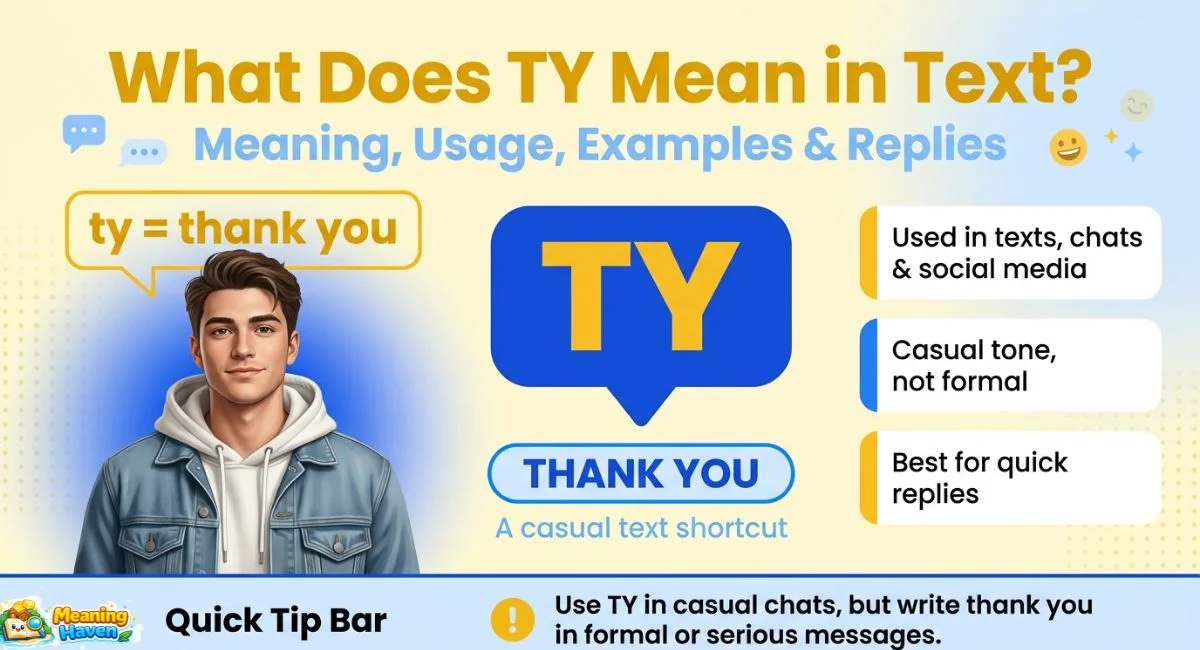
If you have ever seen “ty” in a text and paused for a second, you are not alone. A lot of people feel confused when they see short internet terms in messages, comments, DMs, or gaming chats. The biggest pain point is not just the meaning. It is also the tone. People often wonder: Does ty simply mean thank you, or does it sound too short, cold, or rude?
From reviewing how this term is used across texting, social media, and slang-focused content, one thing is clear: most users want a fast answer, but they also want help with context. They want to know what ty means, where it is used, when it sounds normal, and when it is better to write thank you instead. That is why this guide does more than give a one-line definition. It explains the meaning, tone, usage, examples, and best replies in simple English, so you can understand ty with confidence.
Quick Takeaway
- TY means “thank you.”
- It is mostly used in casual texts, chats, and social media.
- It is usually polite, but it can feel too short in serious or formal situations.
- In work emails or emotional messages, use “thank you” instead.
Meaning of TY
TY is a short form of “thank you.”
People use it when they want to show appreciation fast. It saves time while typing.
If you saw “ty” in a text, DM, comment, or chat, it usually means the other person is saying thank you.
Example:
- “Got it, ty!”
- “Ty for your help.”
Usage of TY
How to Use TY: Context Matters
TY is used in informal communication. It depends on who you are talking to.
Use TY when:
- chatting with friends
- texting family
- gaming or online chats
- social media comments
- quick replies in casual messages
Avoid TY when:
- writing emails
- talking to clients
- professional settings
- emotional or serious conversations
In Casual Conversations
TY feels normal and friendly.
It is common in:
- text messages
- Snapchat replies
- Instagram DMs
- Discord chats
- gaming conversations
Example:
- “Ty bro!”
- “Ty, that helped a lot.”
Full “Thank You”
Sometimes writing “thank you” is better.
Use full words when:
- the message is important
- you want to sound polite
- the situation is formal
- the conversation is emotional
- you are replying to a boss, teacher, or client
Example:
- Casual: “ty!”
- Formal: “Thank you for your support.”
Examples of TY
Here are simple examples:
- “Ty for the info.”
- “Ty, I appreciate it.”
- “Ty so much!”
- “Ok ty 👍”
These examples show that TY is mostly used in quick and casual replies.
Real Conversation Examples of TY
Example 1 (casual chat):
A: “I sent you the file.”
B: “ty!”
Example 2 (gaming):
A: “Nice assist!”
B: “ty bro”
Example 3 (help situation):
A: “Here is the answer you needed.”
B: “ty, that helped a lot”
Example 4 (social media):
Comment: “Love your post!”
Reply: “ty 😊”
Example 5 (slightly formal chat):
A: “I updated the document.”
B: “Ty, got it”
Example 6 (family text):
A: “Dinner is ready.”
B: “ty, coming”
Example 7 (Discord or group chat):
A: “I shared the link above.”
B: “ty!”
Variations of TY
People also use similar forms:
- TYSM – thank you so much
- TYVM – thank you very much
- THX – thanks
- TIA – thanks in advance
These are common in online communication and texting.
TY vs TYSM vs TYVM vs THX vs TIA

Here is the difference:
- TY → simple thank you
- TYSM → stronger appreciation
- TYVM → more polite tone
- THX → very casual
- TIA → used before help
Use:
- TY → quick reply
- TYSM → when you feel more grateful
- TYVM → slightly more formal
- THX → very short and casual
- TIA → when asking for help before getting it
| Term | Meaning | Tone | Best Use |
|---|---|---|---|
| TY | Thank you | Casual | Texts, chats, social media |
| TYSM | Thank you so much | Warmer | When you want to show more gratitude |
| TYVM | Thank you very much | More polite | Semi-formal or extra polite replies |
| THX | Thanks | Very casual | Fast everyday chat |
| TIA | Thanks in advance | Request-based | Before someone helps you |
Emotional Context of TY

TY can sound different based on how you write it.
- ty → normal
- ty! → friendly and happy
- TY → neutral
- ty… → can feel less enthusiastic depending on context
- ty 😊 → warmer and softer
So tone matters a lot.
The meaning stays the same, but the feeling can change.
| Version | Possible Tone |
|---|---|
| ty | neutral |
| ty! | friendly, cheerful |
| TY | plain or neutral |
| ty 😊 | warm, soft |
| ty… | less enthusiastic, depends on context |
TY in Different Platforms
People use TY on many platforms:
- Text messages → very common
- Snapchat → quick replies
- Instagram → comments or DMs
- Discord / gaming → fast chat
- WhatsApp → casual use
TY is popular because it is short and easy to type.
Does TY Mean the Same on Snapchat, Instagram, and Text?
Yes, TY means the same on all platforms.
But the tone can change slightly:
- Snapchat → very casual
- Instagram → friendly, often with emojis
- Text messages → normal everyday use
- Discord / gaming → fast and informal
So the meaning stays the same, but the style may feel different.
TY in Professional vs Casual Use
- Casual → OK to use TY
- Professional → avoid TY
TY is fine in casual chats with friends or family.
But in formal writing, it can look too short.
Example:
❌ “Ty for your email”
✅ “Thank you for your email”
❌ “Ty for your support during this difficult time”
✅ “Thank you for your support during this difficult time”
When Not to Use TY
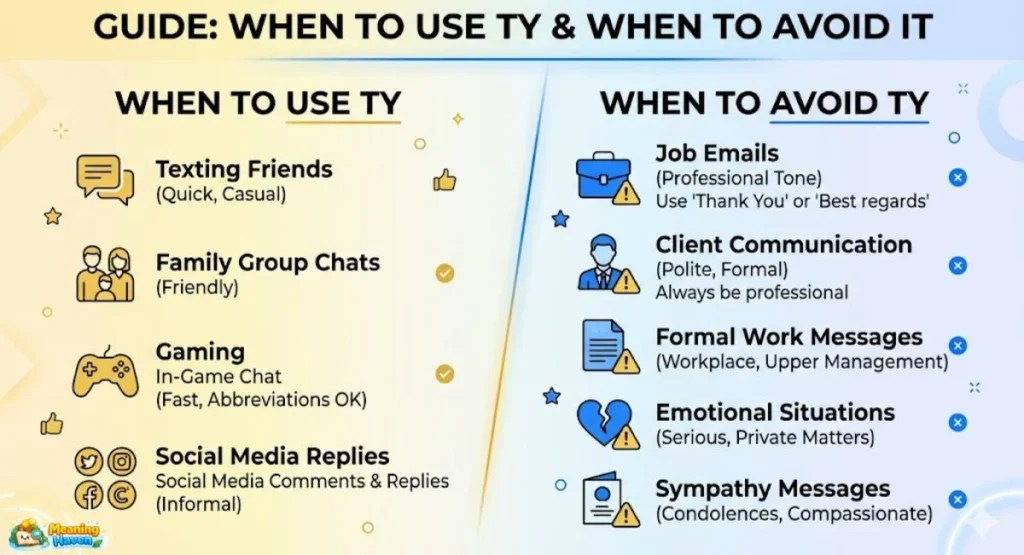
Avoid using TY in these situations:
- job emails
- client communication
- formal messages
- serious conversations
- emotional situations
- school or work messages where a full reply sounds better
Use “thank you” instead when you want to sound respectful, warm, or professional.
| Use TY | Avoid TY |
|---|---|
| texting friends | job emails |
| family chats | client messages |
| gaming chat | formal school or work communication |
| social media replies | emotional or serious situations |
| casual group chats | sympathy or support messages |
When TY Can Feel Rude or Cold
Sometimes, TY can feel too short.
It depends on the situation and tone.
TY may feel rude when:
- someone helped you a lot and you reply only “ty”
- the conversation is serious or emotional
- there is no emoji or extra words
- it sounds like you are in a hurry
- the other person expects a warmer reply
Example:
Friend: “I spent hours helping you.”
Reply: “ty” → may feel cold
Better:
“Ty, I really appreciate it!”
So, TY is not rude by itself. It just depends on context.
How to Respond to TY
You can reply in many ways:
Simple replies:
- “You’re welcome”
- “No problem”
Friendly replies:
- “No worries 😊”
- “Glad to help!”
Professional replies:
- “You’re welcome. Happy to assist.”
How to Respond to TY (More Examples)
Neutral replies:
- “You’re welcome”
- “No problem”
Friendly replies:
- “No worries 😊”
- “Anytime!”
- “Glad I could help!”
Professional replies:
- “You’re welcome. Happy to assist.”
- “No problem at all.”
Playful replies:
- “Got you 😄”
- “Of course!”
These reply options help when you are not sure what to say back.
Best Replies to TY
- You’re welcome
- No problem
- Anytime
- Glad to help
- Of course
Does TY Mean Something Different From a Girl or a Guy?
No, TY means the same.
But tone may feel different based on context.
- “ty 😊” → friendly or warm
- “ty” → neutral
- “ty!” → excited
So the meaning does not change, but the feeling can change based on how it is written.
Similar Abbreviations
Here are common similar terms:
- THX → thanks
- TYSM → thank you so much
- TYVM → thank you very much
- TIA → thanks in advance
These abbreviations are also common in texts, chats, and social media.
Other Meanings of TY
TY can have other meanings, but not in texting.
Examples:
- Tax Year
- Treasury Yield
- Target Year
But in most online chats and text messages, TY means thank you.
Common Mistakes
Avoid these mistakes:
- using TY in formal emails
- using TY in emotional situations
- using TY without understanding the tone
- mixing TY with unrelated meanings
- using TY when a full “thank you” would sound better
Fun Facts About TY
- TY became popular with texting and chat apps
- It is widely used in online communication
- It helps people type faster
- It is easy for beginners and non-native English users to understand
FAQs
What does TY mean in text?
It means “thank you.”
Is TY rude?
No, but it can feel short or cold in some situations.
Can I use TY in emails?
It is better to use “thank you” in emails.
What is TYSM?
It means “thank you so much.”
What does TY mean on Snapchat?
It still means “thank you.” It is just used in a more casual way.
How do I reply to TY?
You can say “you’re welcome,” “no problem,” or “glad to help.”
Best rule: Use TY in casual chats, but use thank you when the message is formal, serious, or emotional.
Conclusion
In my review of this keyword and the way competitors explain it, the main takeaway is simple: TY almost always means “thank you,” but context decides how it feels. That is the part many short glossary articles miss. Users do not only want a definition. They want practical clarity. They want to know whether ty sounds friendly, too casual, or slightly cold in a real conversation.
Based on that expert reading of the topic, the safest rule is this: use ty in casual chats, texts, social media, and gaming, but use thank you in professional, serious, or emotional situations. That gives you the right balance between speed and politeness. If you remember that one rule, you will understand not only what ty means, but also how to use it the right way.

Welcome to Meaning Haven, I’m Muhammad Talha, a content writer and SEO specialist passionate about simplifying word meanings and modern language.
I help readers understand meanings, explore trending slang, and communicate with clarity. My goal is to make language easy, relatable, and useful for everyone.
Let’s explore meanings together!